RSS

Tag Archives: NASA

MAVEN Update – 9/11/14

Ten days until MAVEN is placed into orbit around Mars.

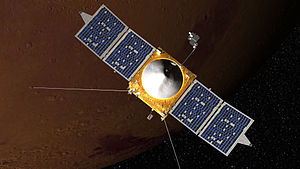
Artists concept of the MAVEN Spacecraft - Courtesy of Wikipedia

Artists concept of the MAVEN Spacecraft – Courtesy of Wikipedia

On November 18th of 2013, I had the enormous pleasure to witness the launch of this space mission along side members of the project team. Our viewing site was at the base of the Assembly Building at the Kennedy Space Center. It was a bucket list event to say the least.

Since then MAVEN has been hurtling toward Mars at over 27,000 miles an hour. All in-flight tests to date have been successful and the control center is buzzing with anticipation of the September 21st when, at 10:23 PM MST, MAVEN will be placed into orbit around the Red Planet. The process is described in this YouTube video.

I am always amazed by the science and mathematics involved in these projects. If the numbers used to calculate the trajectory of Mars, the Earth, or Maven are off, or the length of burn to enter orbit, a multi-million dollar scientific instrument can become just so much space junk. That’s why the term ‘failure is not an option’ is so closely related to the space program.

I am proud of the team who have spent years preparing for this. And, though I will not be able to sit in the control room as MAVEN enters orbit, rest assured that I will be glued to the NASA channel on my television. You will hear me cheering as the final corrections are made. Join with me in celebrating an achievement of dedicated people seeking knowledge that will help us understand one of the mysteries of space and perhaps understand our own planet.

If you are interested in my previous posts on the MAVEN Project, they can be found here.

 
5 Comments

Posted by on September 11, 2014 in MAVEN


Tags: , , , ,

MAVEN – Somethings do take a rocket scientist

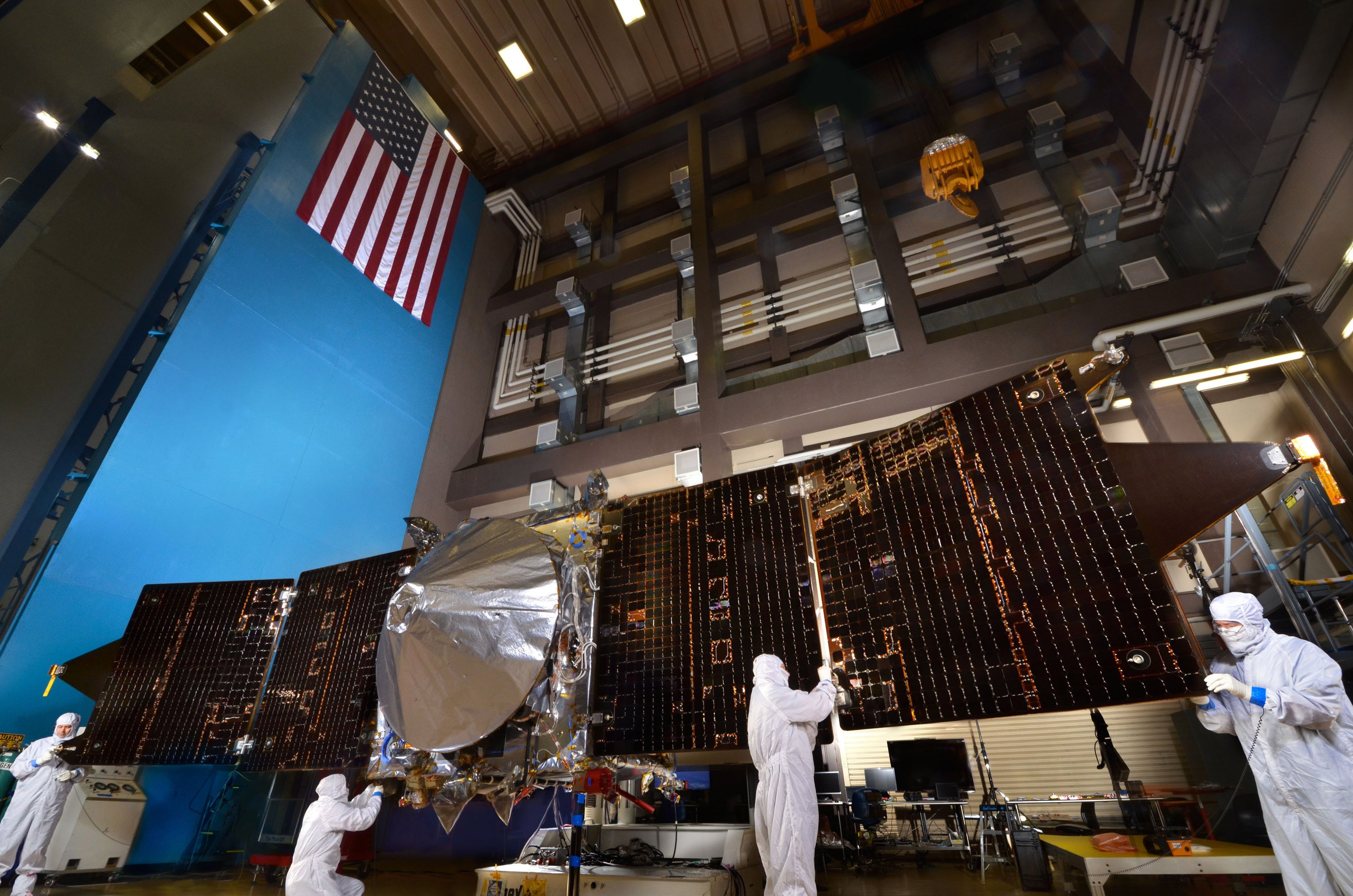
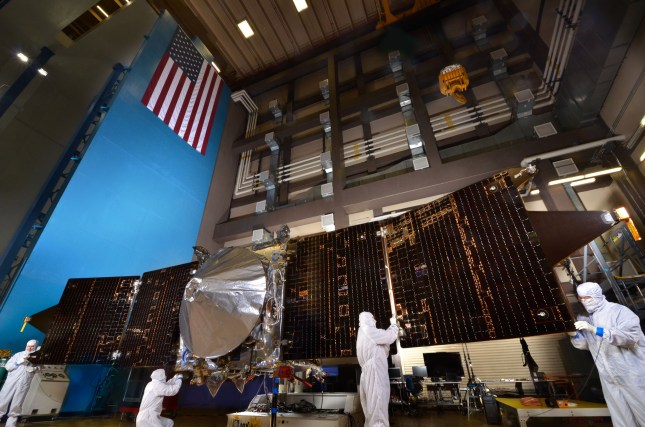
MAVEN in the Clean Room Photo Courtesy of Lockheed Martin Project Team

MAVEN in the Clean Room
Photo Courtesy of Lockheed Martin Project Team

Today, I have a special treat for space enthusiasts, science geeks, and Sci-Fi writers looking for some base background material. I have the privilege to introduce to you and interview a key member of the Mars Atmosphere Volatility EvolutioN (MAVEN) project, Pat Langley. I appreciate Pat taking time out of his crazy busy schedule to sit down and answer a few questions about MAVEN. I have given an overview of the project in previous posts so; in the interest of time let’s get started.

Dennis – So, Pat, who do you work for and what is your relationship to the MAVEN project?

Pat – I work for Lockheed Martin, who built the spacecraft, did the integration, testing, and will be conducting mission operations.  I am the Requirements and Verification Lead, which makes me responsible for ensuring that the spacecraft requirements are properly defined and verified, prior to launch.

Dennis – What do you mean by integration?

Pat – Several of the instruments on the spacecraft were created by other organizations and universities and those instruments need to communicate with the spacecraft. MAVEN, in turn, transmits the instruments data to earth.  Integration is the process of assembling all of the pieces and making sure that they work together.

Dennis – What do you mean by requirements?

Pat – It’s like a child who asks for chocolate cake for their birthday, only not just chocolate cake. It needs to have raspberry filling and not chocolate frosting, but chocolate mousse frosting and number candles, not stick candles. These are requirements.

Dennis – What are some of the requirements for a spacecraft?

Pat – For example:  a spacecraft may need to produce 1000 watts of power. It has to survive the launch environment and it may have to survive the mission environment for five years. It has to have enough propellant to maintain the spacecraft in orbit once it reaches its mission environment, i.e. Mars.

Dennis – Sounds complicated?

Pat – Not complicated, just methodical. You work from a written plan.

Dennis – You mentioned the spacecraft has to survive for a period of time? How long is MAVEN scheduled to survive?

Pat –. The cruise to Mars should take 10 months. The mission, from there, is scheduled to last one year.

Dennis – What happens to it after one year?

Pat – If there is propellant leftover, and there should be, MAVEN will enter either an extended mission and continue to collect science data. Or, serve as a data relay for the current ground assets already on the Martian surface,”Opportunity” and “Curiosity” (the recent rover landing)

Dennis – Is this your first space vehicle-type project?

Pat – No, I have worked a number of other NASA and DOD programs.

Dennis – Any that we might have heard of?

Pat –Magellan, the Venus orbiter, and Orion, NASA’s next deep space human exploration spacecraft.

Dennis – Have you always been interested in space travel?

Pat – No. I went to school to be a Marine Biologist, graduated as an Ocean Engineer, and ended up in the aerospace industry.

Dennis – So, you went from wanting to explore inner space to exploring outer space.

Pat – Yes.

Dennis – I’m assuming that MAVEN wasn’t built-in a weekend. How long has the project been active and have you been working on this project from the beginning?

Pat – I believe that the PI (Principle Investigator) has been working on this for about 10 years.  I have been working on it for four years.

Dennis – This must take a very large project team?

Pat – The numbers varied depending on what is going on at that particular point in the program. When I came on board, there were only about 50 people on the spacecraft team.  At the peak, we were over 200, and that is just the spacecraft.  That does not count the NASA and science instrument teams.

Dennis – That’s a big team. What does a project like this cost?

Pat – NASA says the entire project, spacecraft, launch vehicle, all the science, costs $671 million.

Dennis – Wow!

Pat – Here’s another way to look at it. If you take the $671 million total cost and divided by the U.S. population of 300 million people, it comes to $2 per person, and that’s over the seven years of the project. That’s less than the cost of one cup of Starbucks over seven years.

Dennis – Hmm. With the recent hoopla over the federal budget, that kind of changes the way those big numbers look. Interesting. Okay for the cost of a half of a Starbucks, what benefits would the common taxpayer see from this type of project?

Pat – Exploration stems from human curiosity. MAVEN will give us a better understanding of our neighboring planet and what happened to its atmosphere and the water. Many of the computer models for the MAVEN mission can be used here on our own planet. This all adds into helping answer the age-old question, “Is there, or was there, life beyond our Earth.” Additionally, technologies developed for the space program that public gets benefit from are too numerous to name here. One of the biggest areas is in miniaturization of technology. When ounces matter, making it smaller and lighter is huge. The Space Foundation website has a long list of benefits from space program.

Dennis – The press releases coming out of NASA state that MAVEN data will be used to help determine how the Martian atmosphere has deteriorated over the eons. That sounds a bit like the global warming effect we’ve been hearing about for years. Is that a fair connection for the average person to make?

Pat – No. I would say that the two have nothing in common.

Dennis – Really, please explain.

Pat – We don’t know what caused the atmosphere to deteriorate on Mars. It might have been the loss of its magnetic fields, solar winds, or a multitude of other potential reasons. That’s what we hope the data will help us determine.

Dennis – I read that if MAVEN had been delivered late to the KSC, that the project would have been pushed back 26 months to allow the planets to realign. If that’s the case, and the launch window opens on 11/18, just how narrow is the actual launch window?

Pat – The primary launch window is 20 days, November 18th to December 7th.  We could potentially extend the window a week or two, but that would reduce the length of the primary mission, which is really not desirable.  We had a margin in our delivery and test schedule, so that if we encountered problems along the way, we would not negatively impact in the launch date. I’m happy to say, we’re still on schedule.

Dennis – Will you be directly involved in the launch?

Pat – Yes and no. The spacecraft needs to be powered up several days before launch, and it needs to be monitored while it is powered up. I will be monitoring health and status, the night before and up until four hours before launch. Then I get relieved and can go back to my room to get some sleep…….NOT…..  I will really head to one of the viewing areas and watch the launch.

Dennis – I’m looking forward to seeing the launch as well. Thanks for taking the time to talk to me about MAVEN. Good Luck to you and the team.

To say that I am proud of my brother Pat, would be gross understatement. When someone you have looked up to your whole life is involved in an accomplishment like this project, it validates that you were right to respect that person for the past fifty-four years.

Look forward to more MAVEN posts and tweets in the coming days. T minus 13 days!
 
6 Comments

Posted by on November 7, 2013 in MAVEN


Tags: , , , , , , ,

MAVEN – update

I stated in a previous post that my brother is involved on the MAVEN space project which is scheduled to launch in November. I thought I would provide a little background on the project and as the launch date approaches, give you some accounting of the launch prep and firsthand impressions of the launch itself.

T minus twenty-eight days and counting!

M- Mars

A- Atmosphere

V- Volatile

E- EvolutioN

The goal of MAVEN is to determine the role that loss of atmospheric gas to space played in changing the Martian climate through time. Where did the atmosphere – and the water – go?

MAVEN will determine how much of the Martian atmosphere has been lost over time by measuring the current rate of escape to space and gathering enough information about the relevant processes to allow extrapolation backward in time. – NASA website.

The Mars Atmosphere and Volatile Evolution spacecraft is currently at the Kennedy Space Center undergoing thorough tests of software and hardware systems. You can view launch preparations live on NASA’s Kennedy Space Center webcams at: http://countdown.ksc.nasa.gov/elv/. (Note – This link requires a JAVA download.) These activities are in preparation for a November 18 launch date.

The MAVEN spacecraft must be able to orient itself, aim its instruments in the right direction, carry out steering maneuvers to communicate with Earth and stay on its Mars-bound course. The processing team must verify critical systems to insure the spacecraft will be able to perform these tasks during its journey. MAVEN’s steering thrusters and star-tracker guidance system were previously tested and final flight software installed. At approximately 5,400 pounds, it takes and big launch vehicle to put it into a trajectory to reach Mars in ten months.

The Atlas V 401 rocket that will launch MAVEN toward Mars arrived in Florida on Aug. 26. The rocket, built by United Launch Alliance of Centennial, Colo., will stand nearly 200 feet tall when fully assembled.

Atlas V (401) launches with Iro and Icross Satellites

An Atlas V (401) launches with satellite

According to the NASA website, MAVEN will not be rolling about on the surface looking for clues to the planet’s heritage. Instead, MAVEN will orbit high above the Red Planet in the upper atmosphere searching for signs of what changed over the eons and why.

The mission will use instruments that can pinpoint trace amounts of chemicals high above Mars. The results are expected to test theories that the sun’s energy slowly eroded nitrogen, carbon dioxide and water from the Martian atmosphere to leave it the dry, desolate world seen today.

That kinda sounds like global warming, doesn’t it? However, I want to stick to the facts and not speculate on what the mission may or may not find out. Some of the details regarding the project management are really cool. Talk about a deadline, if the Maven spacecraft was late getting to the Launch site. The entire project would need to be postponed 26 months until the planets realigned! No kidding.

For future posts, I’m trying to obtain an interview with one of the key mission participants which I hope would be a very interesting conversation. Also, I will take deeper look at some of the other Mars missions and what sorts of interesting tidbits have been gleaned from them that relate to the MAVEN mission.

 
22 Comments

Posted by on October 21, 2013 in MAVEN


Tags: , , , , , ,

Link fixes and MAVEN

First I need to apologize. In my previous post the link to my guest post was broken for a time. I fixed it however, many of you indicated you had some difficulty with it. So for those of you who would like to read my guest post from last week, here is the link.

Fantasy, the purest form of fiction.

Now for some interesting news. I received a call from my brother who works for Lockheed-Martin, an aerospace contractor. He proceeded to tell me that a launch date was set for the project he has been working of for several years. The project is called MAVEN and stands for, the Mars Atmosphere and Volatile Evolution spacecraft. According to NASA:

The  MAVEN mission, scheduled for launch in late 2013, will be the first mission devoted to understanding the Martian upper atmosphere.

The goal of MAVEN is to determine the role that loss of atmospheric gas to space played in changing the Martian climate through time. Where did the atmosphere – and the water – go?

MAVEN will determine how much of the Martian atmosphere has been lost over time by measuring the current rate of escape to space and gathering enough information about the relevant processes to allow extrapolation backward in time.

-according to NASA Mission pages website.

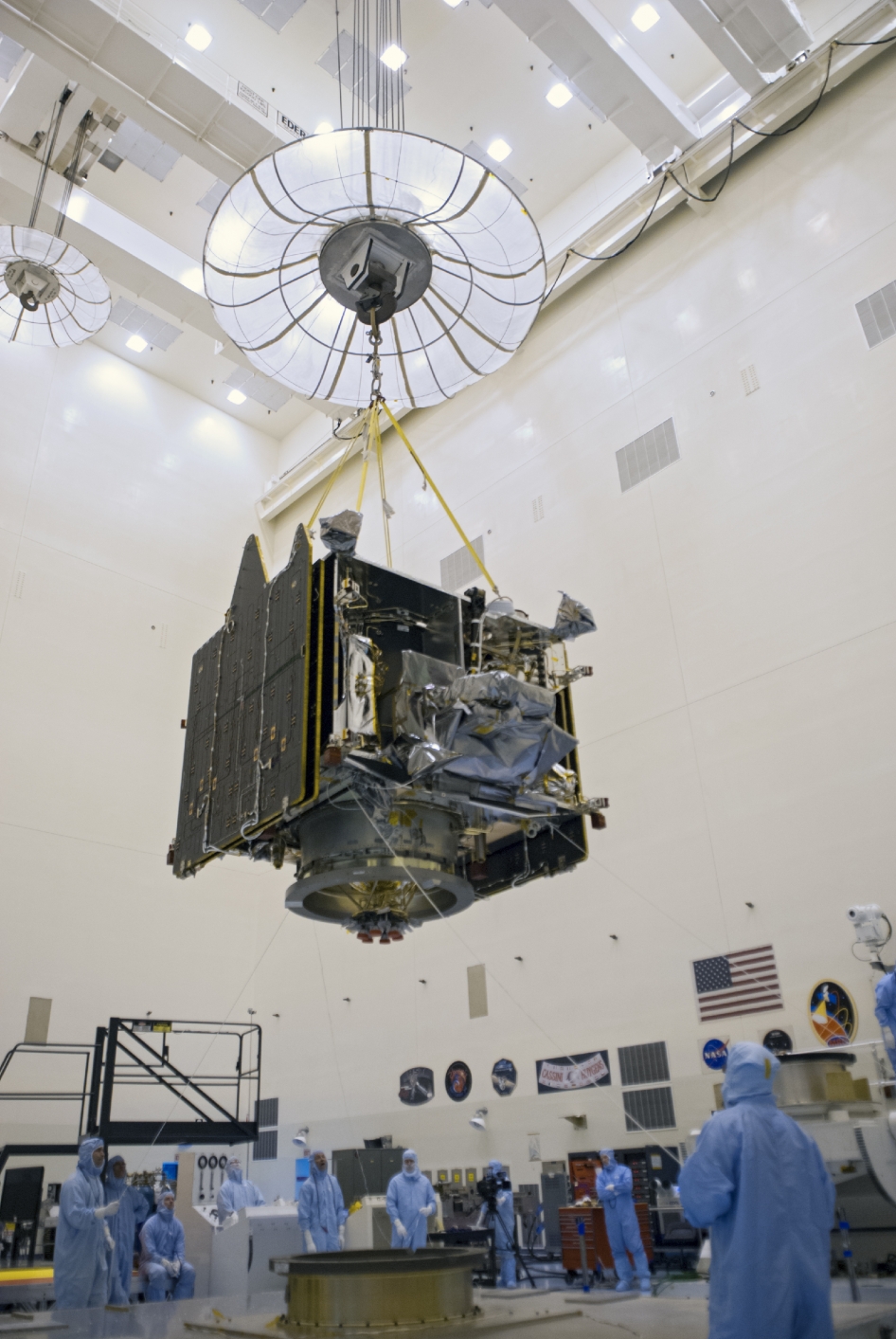
Unloading MAVEN spacecraft at KSC (Photo credit NASA photo library)

Unloading MAVEN spacecraft at KSC (Photo credit NASA photo library)

My brother has been the requirements and verification lead relating to the MAVEN space vehicle. His responsibilities included overseeing the definition of the spacecraft and ensuring that all requirements are met. Sounds cool doesn’t it? Hell, I get goosebumps just writing about it. Anyway, after years of work by a large team of individuals, it is finally going to launch.

Since I have a personal interest in this event, it is my intention to post periodic blogs relating to preparation for the launch and hopefully, the launch itself. If you have specific questions relating to the project, I will try to obtain correct answers and provide them during followup posts.

This is just plain cool!

 
8 Comments

Posted by on September 16, 2013 in MAVEN


Tags: , , , , ,