RSS

Author Archives: Dennis Langley

My Great Nephew’s Perfect Meal

I finally got around to looking at my Thanksgiving day pictures and one really stuck out. there is a story behind it so I will make you wait for the picture.

My great-nephew started college this year and is doing well. He is full of fun and life. When he was young, he looked like a refugee from Ethiopia. Nothing but skin and bones. Somewhere along the way he grew up. Maybe it’s because he started to eat. He now could be an offensive lineman for his college football team.

As Thanksgiving is celebrated with a large meal which takes some planning to create. He and I started talking about how we would eat the delicious meal that his grandmother prepared. His perfect meal is what follows.

Start with two rolls split in half and place face up on a plate.

Cover the rolls with slabs of turkey breast.

Add enough mashed potatoes to cover the turkey.

Smother the mashed potatoes with stuffing.

And, drown the entire plate with gravy.

The perfect Thanksgiving Day Meal

The Perfect Thanksgiving Day Meal on a 12 inch dinner plate!

Now that’s several thousand calories you’re looking at. And, not a vegetable in sight. However, he was not finished.

What would Thanksgiving dinner be without dessert?

So, he added a slice of homemade apple pie, ice cream, and a healthy serving of Butterfinger Bar Bread Pudding.

Whew! My arteries are hardening just writing this!

Finally, he sat back on the sofa with a contented look on his face having created and eaten the perfect meal.

But, the story does not end there. Unbeknownst to him, a colony of microscopic organisms were at work in his body getting ready to pounce on this unsuspecting young man. Twelve hours after the meal, the flu hit him like a freight train. He spent the entire night and the next day in utter misery. Unfortunately, his perfect meal made a return visit if you get my meaning…

He recovered in a few days as most young men do. He even joked about it on Twitter. But…I could hear the pain in his tweet at having wasted the perfect meal.

There’s always next year.

NOTE: If he gives me any static about this post, I will follow-up with a picture of him eating his perfect meal. 🙂


Tags: , , , , ,

Tribute to a dear friend

Good-bye, Dave.

Good-bye, Dave.

On Saturday, a star fell from the sky. My friend David Holland passed away after a twenty-year long fight with cancer. The depth of this man and the impact he made on those around him cannot be measured with words.

We met while volunteering for the Boy Scouts of America. Correction, I was volunteering. Dave lived it and breathed it. For years, he was the Scoutmaster to a troop of 100 boys! Only Dave could pull that off. After he ‘retired’ from being a Scoutmaster, he continued to support the Scouting movement by working at the district level. He always put the boys first, no matter what.

At the time we met, I was thirty, married with no kids. As an Eagle Scout, I wanted to give back to the program that had done so much for me in my youth. Dave got a call from the district office that I was looking to get involved. Dave met with me and we hit it off. I found out later that he not only did a background check on me, but he stood up for me when several of the parents questioned him about my interest in the troop, since I had no son of my own.

Outside of my own family, I can think of no one that respect more than Dave. We spent several lifetimes sharing stories and adventures around campfires. He was a story teller and one of the first persons to encourage me to write. He was truly a good man and a good friend.

I will miss him.

May the great Scoutmaster of all great Scouts, be with us until we meet again. – Boy Scout Prayer

Mitakuye Oyasin!

 
15 Comments

Posted by on December 3, 2013 in Other Strangeness


The U.S. Space Program

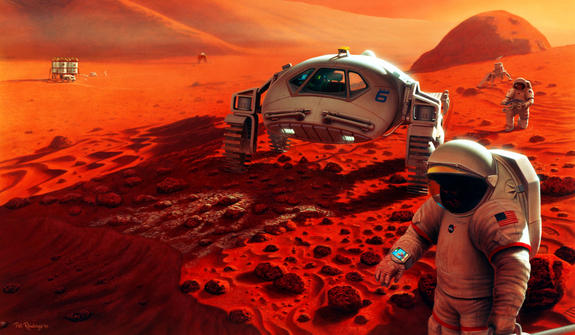
Is this the future of the Space Program? Artist's concept drawing. courtesy of NASA

Is this the future of the Space Program?
Artist’s concept drawing. Courtesy of NASA

Fifty-plus years ago, a young man stood up in front of the American people and declared that we would put men on the moon. We did! Four years after the moon landing, the Space Shuttle program was approved.

The two men responsible for these huge steps could not have been more different if I’d created them for a piece of fiction. Former Presidents John F. Kennedy and Richard Nixon. Even though President Eisenhower originally approved funding for the Apollo program, history sees Kennedy as the driver behind putting men on the moon. Kennedy and Nixon did have at least one similarity. They both believed in the Space Program. It is sad that the leaders since then have not had the same vision or courage shown by leaders of the fifties, sixties, and seventies. Funding has been cut to the point where, even if funding came through today, it would take nearly a decade for the U.S. to put a manned vehicle back into space. We have chosen to rely on Russia to ensure the safe travel of our brave astronauts to and from the International Space Station. The cost of which jumped 300% the day we announced the retirement of the space shuttles. In addition, 7,000 jobs were lost to the small towns that surround Cape Canaveral when the Shuttle program was cancelled. Thirst for human exploration and knowledge has driven us to this point. What will it take to move us to the next step? Substantial fiscal payback will most likely be needed to push Congress and the President off of top-dead-center and move them to act in support of NASA. Okay, enough politics, I’m trying to keep from entering into a rant.

When I was ten years old a man stepped onto the surface of the moon. To say I was excited would be an understatement. At eighteen, I visited the Kennedy Space Center for the first time and got to look inside rockets for the first time. I was impressed but, I still didn’t understand. Thirty-four years later, I went back. I watched first hand, as a rocket launched into space. I felt the rush of excitement and patriotism. I walked in the steps of the bravest men, in my opinion, who have ever walked the earth. My imagination was electrified by the sights and sounds of exploration. With the help of the Hubble Telescope, I saw images of the possibilities and the probabilities of other “earths’ being out there. Mathematically, it is almost certain!

If only we had a way to get there!

The past few months have renewed my belief in the U.S. Space Program. The men and women who work on these projects are the finest in the world. They are driven by an insatiable need to learn, to explore, to try, and to succeed. The benefits the program has provided humanity are irrefutable. The need for the people of  Earth to find and learn about other planets could very well save us from ourselves.Will we find a way to safely travel into deep space? I have no doubt that it can and will be done.

I hope I get to see it happen in my lifetime.

What about you? If you had the opportunity to go into space, would you?

 
3 Comments

Posted by on December 2, 2013 in MAVEN, Other Strangeness


Tags: , , , , ,

MAVEN – Kennedy Space Center Visit

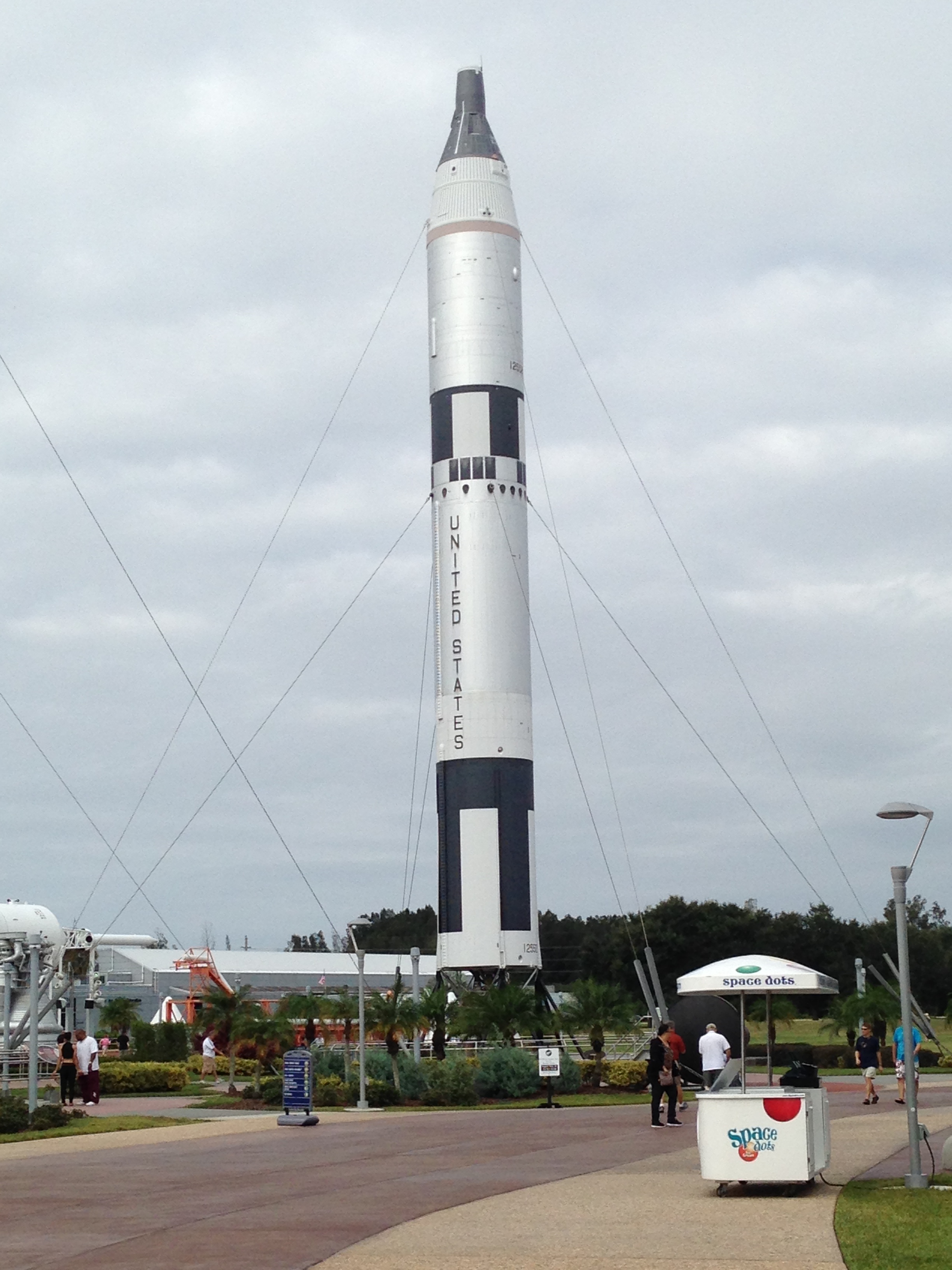
Gemini rocket that sent US Men into orbit around earth.

Gemini rocket that sent US Men into orbit around earth.

MAVEN was on its way to Mars. With that behind us, my brother Pat and I went to the Kennedy Space Center’s visitor center for some R&R. This was my first trip back in over fifteen years. The Kennedy Space Center (KSC) is one of those places that every US citizen should visit at least once in their lifetime. In addition, anyone who has an interest in space should make the pilgrimage to this source of knowledge on space exploration. When you walk through the gate, the first thing you see is the “rocket garden”. This collection of full-sized rockets gives new meaning to the words “The Right Stuff”. The Mercury and Gemini missions which put the first US men into space are quite small compared to the launch vehicles of today. With limited technology compared to today, these men squeezed into capsules the size of a medium-sized dinner table, which were placed on top of ballistic missiles. Were they brave or just plain nuts? A ‘new’ feature of the “Garden”, at least for me, was the swing arm from the Apollo launch pad. This was the real walkway that Neil Armstrong, Michael Collins, and Buzz Aldrin used to enter the Command Module atop the Saturn V rocket that would take them to the Moon. That short walk along the steel walkway Made the hair stand up on my arms. At the end of the walkway was one of the practice capsules they used to prepare for the mission. Three men in a capsule the size of a large dinning room table. There were no padded seats and the harnesses were simple web straps. Once again, brave or nuts? These guys were mostly test pilots so they had a large amount of adrenaline junkie in them. But still… The Saturn V that sent them to the moon was larger than anything previous built by the U.S. One engine of the Saturn V provided as much thrust as all eight engines of its little brother the Saturn 1B. And, there were five of those engines. Check out the picture.

One Saturn V engine beside a six foot tall man. The smaller Saturn 1B is in the background

One Saturn V engine beside a six foot tall man. The smaller Saturn 1B is in the background

We decided to catch a couple of movies at the IMAX theatres. The first was on the history of the International Space Station (ISS). Watching how it came together and how many nations worked in tandem to make it happen was amazing. Countries that once wanted nothing more than to eradicate each other using missiles, were able to build modules that fit together perfectly and functioned as promised. The principals were the space agencies of the United States, Russia, Europe, Japan, and Canada.  European Space agency partners include: Belgium, Denmark – DNSC, France – CNES, Germany – DLR, Italy – ASI, Netherlands, Norway – NSC, Spain – INTA, Sweden – SNSB, Switzerland, and the United Kingdom. The science that is coming out of the ISS is helping the world. I found the medical research especially interesting. The most moving portion of the film for me was a quote from on of the astronauts. While on the screen, we were looking at a view of Earth with the continents clearly visible, The astronauts explained the following: “Astronauts are given a unique gift. We  can see the world as a whole. A world without lines or labels. we are truly one people, sharing this beautiful planet, together.” With this type of cooperation, what are the possibilities?

The second film presented the Hubble Telescope. It took several Shuttle trips to finally get it working properly. But the results are nothing short of overwhelming. The film took us on a trip through space using pictures from Hubble and creating 3D images. As Leonardo DiCaprio explains, “Billions of galaxies, each with billions of stars. Could it be possible that other Earth-like planets exist?” The percentage are certainly there. The problem lies in where are they and how do we get there? We are talking about planets, billions of light years away. That’s why it’s called the universe.

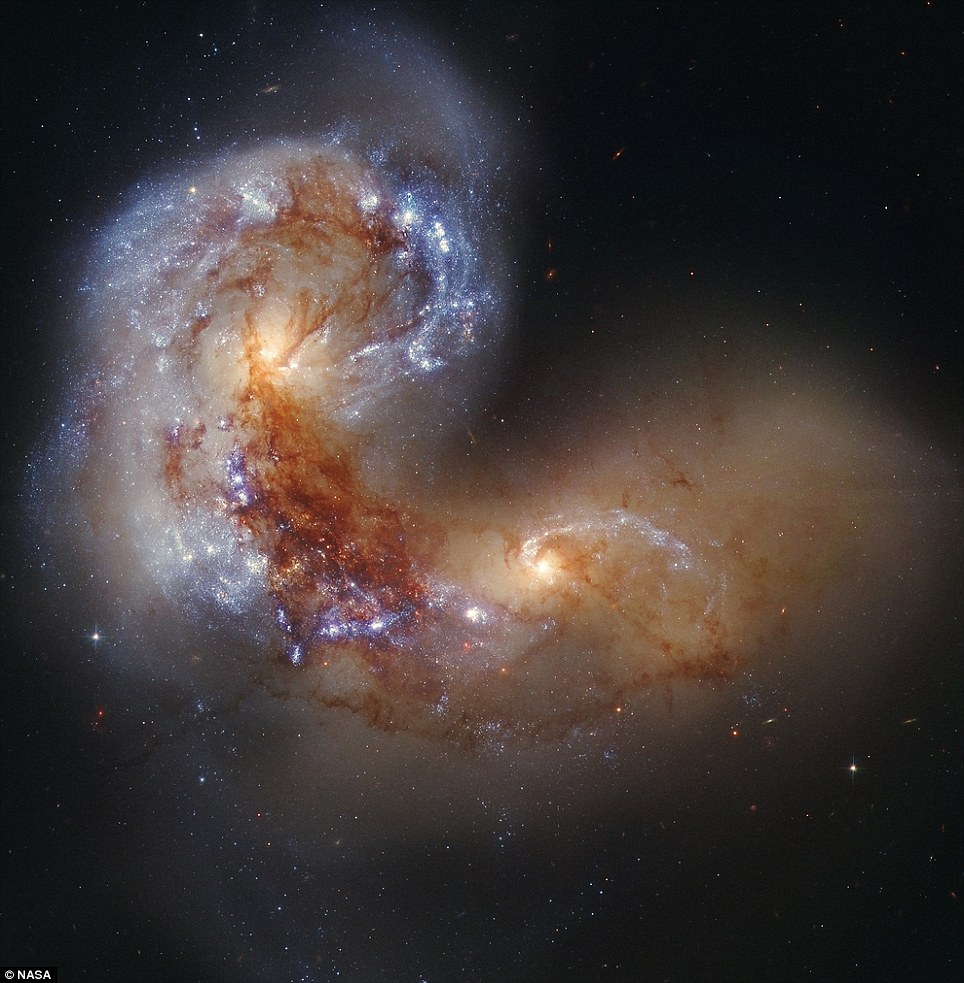
An Exploding galaxy taken by Hubble. Courtesy of NASA

An Exploding galaxy taken by Hubble. Courtesy of NASA

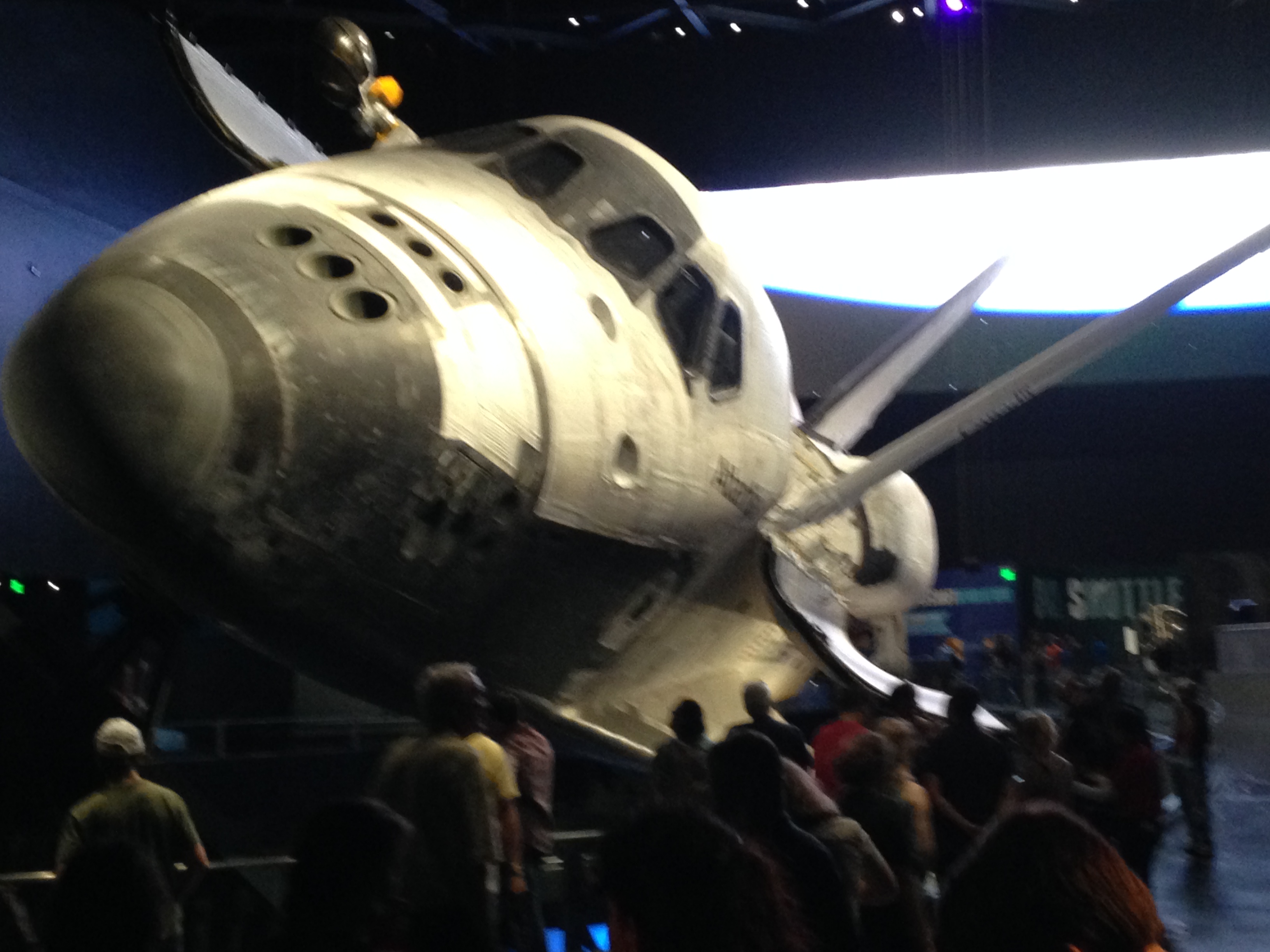
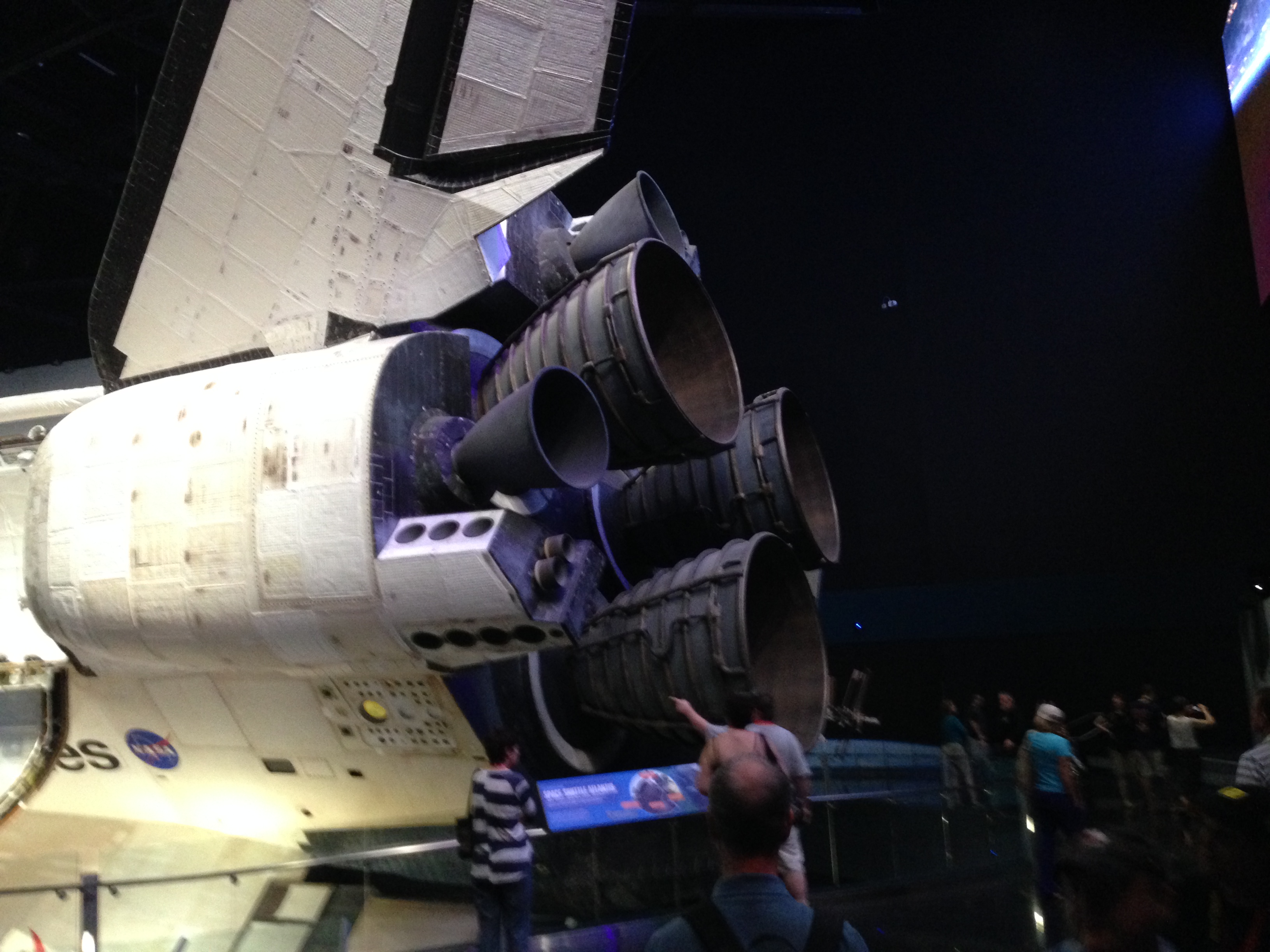
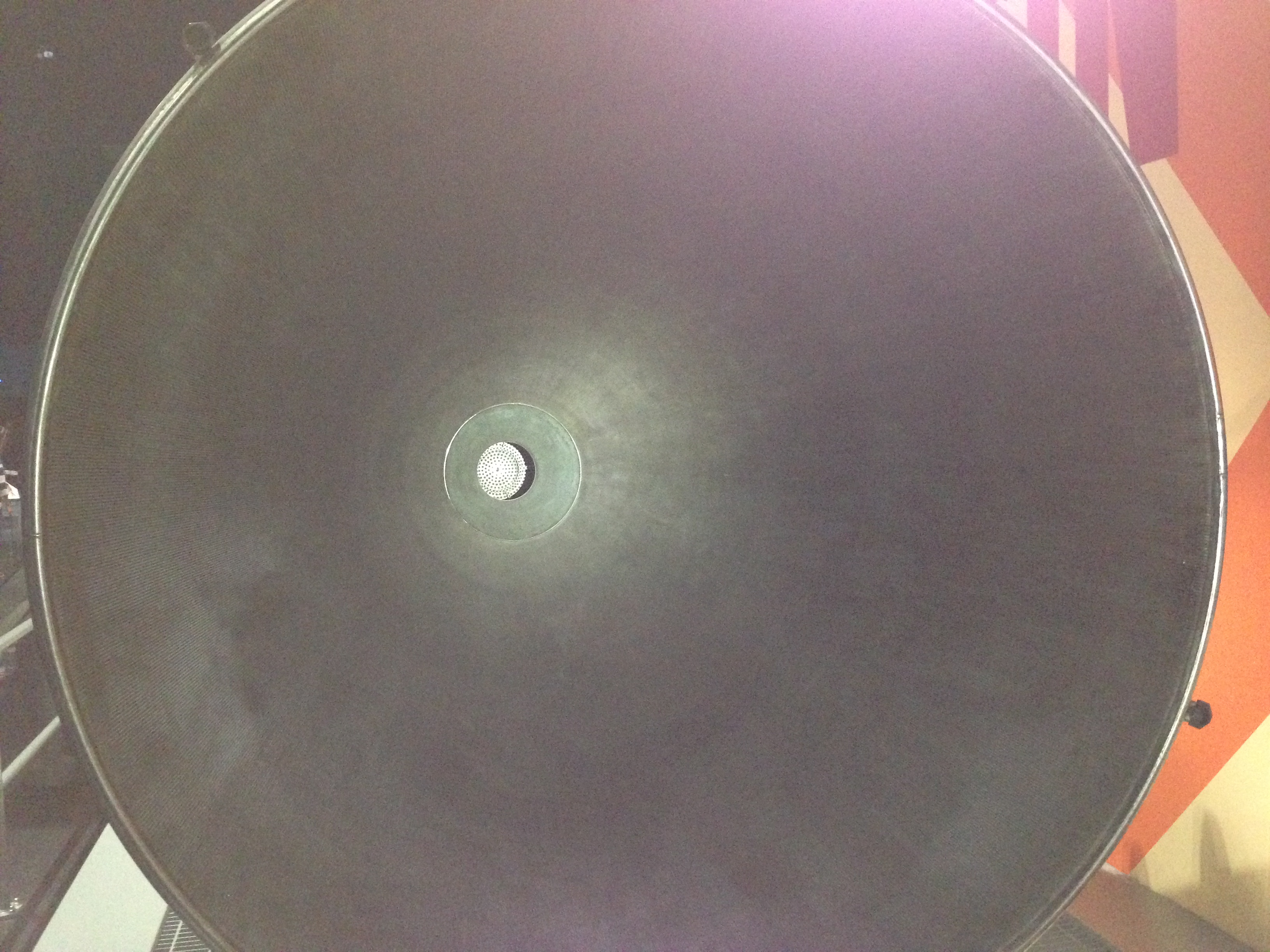
The last exhibit we saw was the newest addition to the KSC visitor center. The space shuttle Atlantis. I’ll let the pictures do the talking.

Not a small plane.

Not a small plane.

Plenty of room for your luggage

Plenty of room for your luggage

The business end of Atlantis

The business end of Atlantis

When this lights up, you would be standing in hell itself, for a fraction of a second before you became ash.

When this lights up, you would be standing in hell itself, for a fraction of a second before you became ash.

Atlantis was so close you could almost touch it. You could easily see the streaks across the heat tiles from the fiction of re-entry. It was hard to control my imagination while standing this close to “Real History”. There were so many OMG moments during our visit that by the time came to leave, the trip back to the motel was very quiet indeed.

My next post will be my last on this topic for a while. However, I will wrap up my experiences on this brief journey and pose some questions about the space program and our future. .

 
8 Comments

Posted by on November 25, 2013 in MAVEN


Tags: , , , , , ,

MAVEN – The Launch

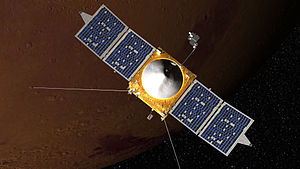
Artists concept of the MAVEN Spacecraft - Courtesy of Wikipedia

Artists concept of the MAVEN Spacecraft – Courtesy of Wikipedia

Well, I made it back. I left 70 degrees and sunny in Cocoa Beach, Florida to return to 40 degrees and overcast with a sharp wind in Minneapolis, Minnesota. My trip to watch the MAVEN launch turned out to be a ‘bucket list’ event of the grandest scale. I decided to write three separate posts on my experience, the launch itself, my visit to the Kennedy Space Center, and my overall impressions of the trip, including a video of the launch.

MAVEN is on her way to Mars at 17,500 miles an hour. Yes, that is not a typo. And even at that speed, it will take 10 months to reach the Red Planet at approximately 200 million miles away.

The morning of November 18th dawned with a light haze and a forecast for late afternoon thunder showers. The launch window opened at 1:28PM EST so, it was a race with the weather as clouds and rain began to build in the northwest.

The clouds were moving in.

The clouds were moving in.

My brother Pat worked the night shift at the operations console where they monitored MAVEN’s status. This allowed the primary launch team to get some rest and be fresh for the launch. The Ops Manager gifted Pat with a parking pass that allowed five of us to watch the launch from the employees viewing area near the Vehicle Assembly Building (VAB) (NASA loves acronyms). The VAB is roughly four miles from the Complex 41 launch pad. This is the closest anyone would be when the Atlas V fired its engines. I would later be grateful for that distance between me and the rocket. When we reached the VAB, support tents were set up near the grandstand and guests were beginning to arrive. Through the many loudspeakers around the viewing area, we could hear the launch technicians working through their pre-launch checklists. Status reports came in from the fueling team as the liquid oxygen and kerosene were pumped into the fuel tanks. The crowd grew and lawn chairs were added to the grandstand and folding chairs already provided. Excitement filled the air as the crowd eagerly anticipated the launch.

At T-4 minutes the countdown entered a mandatory 10 minute hold to facilitate last-minute checks. Looking at the clouds continuing to build, I said to no one in particular, “Screw the ten minute hold. get the bird in the air.” Just before the end of the ‘hold’ the launch director called roll on all systems. He called each system name in a prescribed order and was responded to with a firm “GO”. Once all systems gave him the “GO”, he stated,”We are a  go for launch.” The countdown continued.

At T-30 seconds the crowd went quiet. Everyone was on their feet and cameras were ready.

At zero we waited as nothing seemed to be happening. At four miles away there were trees covering the launch pad. The announcer said, “We have lift off”. And suddenly we saw the launch fairing above the trees. Then the bright tail of the atlas engine lit up the tree tops. A second later a crack split the air and was followed by the crush of the engine noise. At four miles it was uncomfortable. Any closer and it would have been painful. The roar pounded on my chest as I tried to keep my camera phone steady and focused on MAVEN. It was surreal to watch as MAVEN started toward the clouds. Slowly at first, it seemed to hang in the air, barely climbing at all. Gradually it accelerated as the bright yellow tail as long as the rocket itself pushed the spacecraft up and away from Earth.

MAVEN rises above the tree line. The sound was Crushing!

MAVEN rises above the tree line. The sound was Crushing!

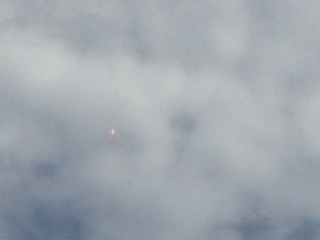
We watched in awe for a few seconds until MAVEN disappeared into a cloud. Several more seconds passed before it broke out of the cloud and continued to streak upward. My hands were shaking so bad that I had to readjust the camera constantly to keep MAVEN in the viewfinder.

My last view of MAVEN as she heads for Mars

My last view of MAVEN as she heads for Mars

Sixty-four seconds after the zero count, MAVEN disappeared from view. The last visible sign was the glow from the engine blast fading away into the building clouds. Only then did the crowd begin to cheer. I found myself simply staring up at where MAVEN had disappeared with tears rolling down my face. I slid my phone into my pocket and looked around to see that I was not the only one overwhelmed by the experience.

I never thought this type of event would be so emotional. There are no words to describe the feelings I felt. I could not tell if it was because Pat was involved with the project, or if it was my patriotism, or possibly just the release of raw emotion drawn from me by the crush of MAVEN’s engine. Maybe it was a combination of all of them.

A man standing behind me had retired from NASA. He had witnessed the Gemini mission launches which put the first US men into orbit, and he had sat in the launch center during Apollo and Shuttle launches. This man who had witnessed almost the entire history of the space program had tears in his eyes.

I spoke to my brother after he put his video camera away and he said it was bittersweet to see something he had spent five years helping to create disappear into the clouds. He would never see MAVEN again.

Approximately 90 minutes after lift off, somewhere over the eastern coast of Australia, The second stage (Centaur) of the Atlas rocket fired and sent MAVEN out of Earth’s atmosphere and on its way to Mars. The status report came in that all systems were functioning nominally (that’s normal for us normal folks). It was party time for the project and launch teams. All I will say about partying with rocket scientists is this. It’s a lot like partying with a bunch of sci-fi/fantasy writers. However, there are a lot fewer piercings and less multicolored hairdos with the rocket scientists.

The good news for Pat is that he is transferring to the operations team and will be writing commands for MAVEN when she reaches Mars next September. With luck, he’ll be able to work with MAVEN until the mission ends in 2015. I hope he can.

Coming up next: My visit to the visitor’s center at the Kennedy Space Center. you won’t want to miss this!

 
6 Comments

Posted by on November 22, 2013 in MAVEN


Tags: , , , , , ,

Building a Spaceship to Mars

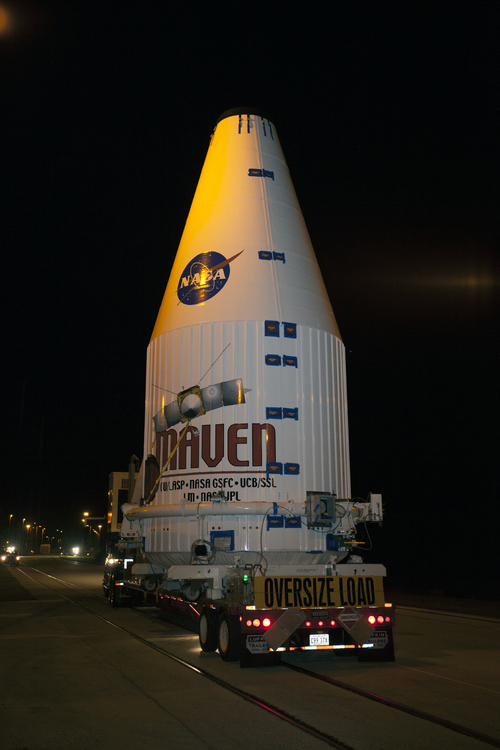
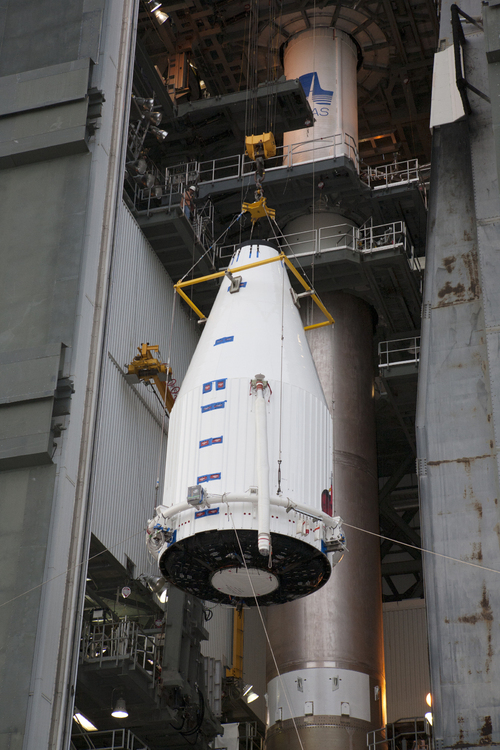
MAVEN within the launch shroud on its way to the assembly building at Complex 41

MAVEN within the launch shroud on its way to the assembly building at Complex 41


MAVEN – One who understands.


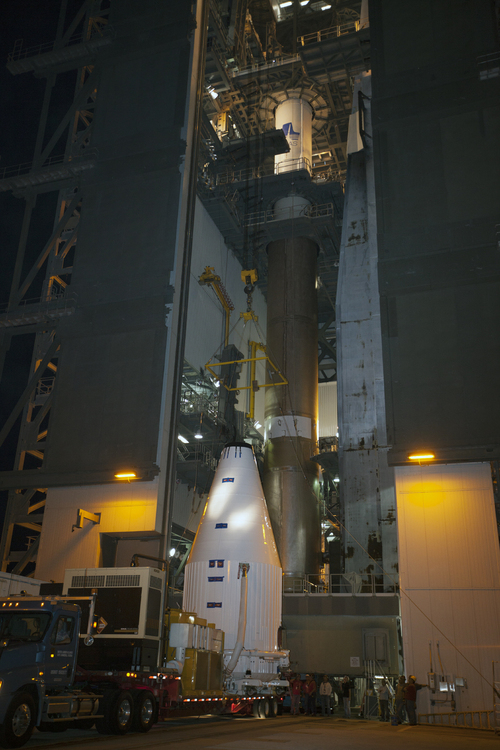
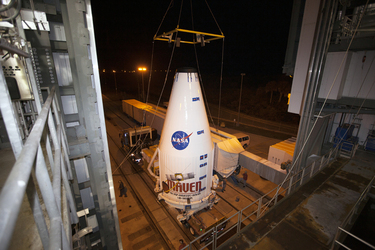
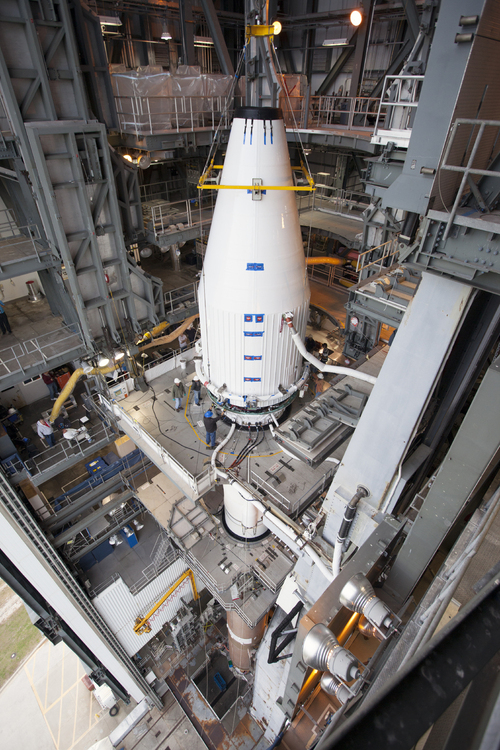
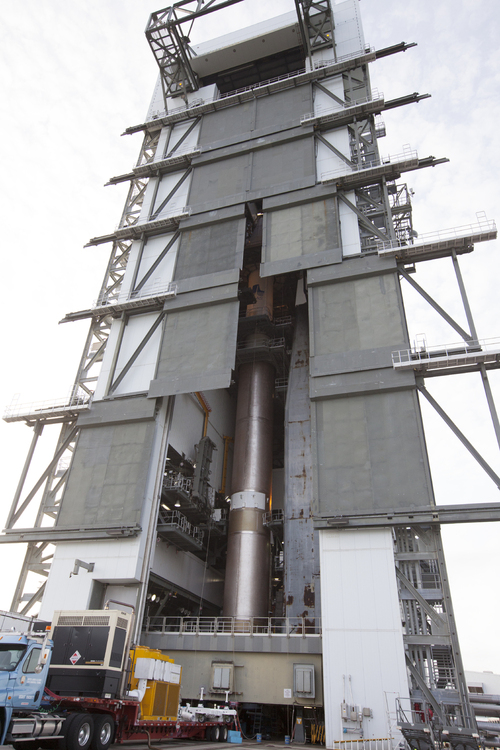
If you have been following this blog you know that I have a connection to the MAVEN mission to Mars. I have been trying to provide background and updates on the project in preparation for the launch window which opens next Monday, Nov. 18. Shortly after my last post, I received and e-mail from the project team with photos from the Complex 41 Vertical Integration Building. Don’t you just love these scientific terms? What in means is they were putting a spacecraft together. So here are some pics showing MAVEN being lifted to the top of the Atlas V 304 launch vehicle. All pictures are used with permission and are courtesy of NASA and the Lockheed Martin, MAVEN project team.

MAVEN arrives at the assembly building at Complex 41

MAVEN arrives at the assembly building at Complex 41


That’s the Atlas V launch vehicle already in the building. Note the people standing next to the truck. This is not a small vehicle.

Lowering the sling to take MAVEN for a ride to the top
MAVEN On its way up

MAVEN On its way up


Here’s a better view of the Atlas V launch vehicle in the background.

MAVEN almost to the top

MAVEN almost to the top

MAVEN Settling in place

MAVEN Settling in place


Now that is a

Looooooong way down!

The doors are closing.

The doors are closing.


This is where MAVEN will stay until it’s time to move to the launch pad.

Launch time is scheduled for 11/18/13 1:28 EST.

T minus 91 hours!

 
5 Comments

Posted by on November 14, 2013 in MAVEN, Other Strangeness


Tags: , , ,

MAVEN – Somethings do take a rocket scientist

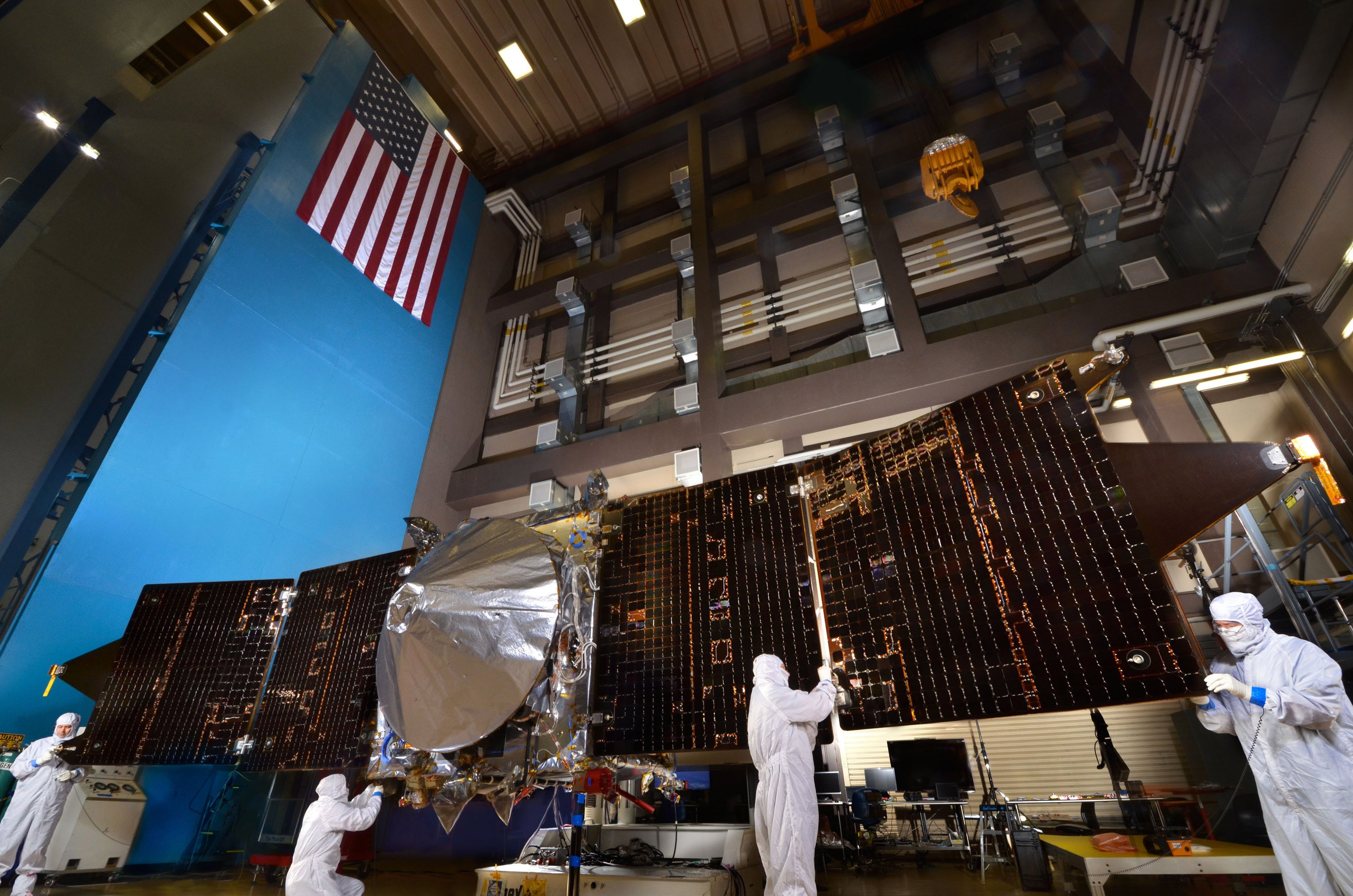
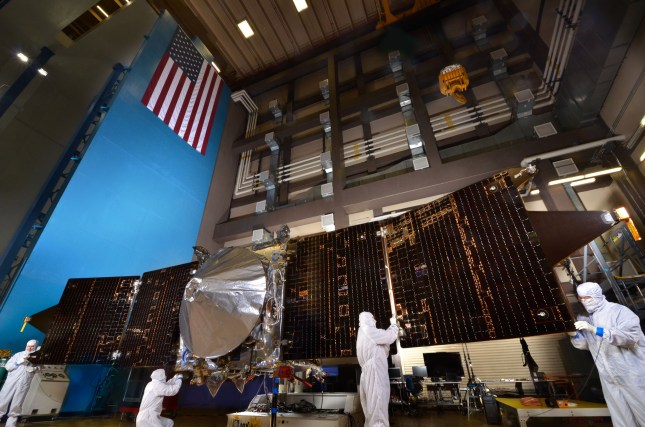
MAVEN in the Clean Room Photo Courtesy of Lockheed Martin Project Team

MAVEN in the Clean Room
Photo Courtesy of Lockheed Martin Project Team

Today, I have a special treat for space enthusiasts, science geeks, and Sci-Fi writers looking for some base background material. I have the privilege to introduce to you and interview a key member of the Mars Atmosphere Volatility EvolutioN (MAVEN) project, Pat Langley. I appreciate Pat taking time out of his crazy busy schedule to sit down and answer a few questions about MAVEN. I have given an overview of the project in previous posts so; in the interest of time let’s get started.

Dennis – So, Pat, who do you work for and what is your relationship to the MAVEN project?

Pat – I work for Lockheed Martin, who built the spacecraft, did the integration, testing, and will be conducting mission operations.  I am the Requirements and Verification Lead, which makes me responsible for ensuring that the spacecraft requirements are properly defined and verified, prior to launch.

Dennis – What do you mean by integration?

Pat – Several of the instruments on the spacecraft were created by other organizations and universities and those instruments need to communicate with the spacecraft. MAVEN, in turn, transmits the instruments data to earth.  Integration is the process of assembling all of the pieces and making sure that they work together.

Dennis – What do you mean by requirements?

Pat – It’s like a child who asks for chocolate cake for their birthday, only not just chocolate cake. It needs to have raspberry filling and not chocolate frosting, but chocolate mousse frosting and number candles, not stick candles. These are requirements.

Dennis – What are some of the requirements for a spacecraft?

Pat – For example:  a spacecraft may need to produce 1000 watts of power. It has to survive the launch environment and it may have to survive the mission environment for five years. It has to have enough propellant to maintain the spacecraft in orbit once it reaches its mission environment, i.e. Mars.

Dennis – Sounds complicated?

Pat – Not complicated, just methodical. You work from a written plan.

Dennis – You mentioned the spacecraft has to survive for a period of time? How long is MAVEN scheduled to survive?

Pat –. The cruise to Mars should take 10 months. The mission, from there, is scheduled to last one year.

Dennis – What happens to it after one year?

Pat – If there is propellant leftover, and there should be, MAVEN will enter either an extended mission and continue to collect science data. Or, serve as a data relay for the current ground assets already on the Martian surface,”Opportunity” and “Curiosity” (the recent rover landing)

Dennis – Is this your first space vehicle-type project?

Pat – No, I have worked a number of other NASA and DOD programs.

Dennis – Any that we might have heard of?

Pat –Magellan, the Venus orbiter, and Orion, NASA’s next deep space human exploration spacecraft.

Dennis – Have you always been interested in space travel?

Pat – No. I went to school to be a Marine Biologist, graduated as an Ocean Engineer, and ended up in the aerospace industry.

Dennis – So, you went from wanting to explore inner space to exploring outer space.

Pat – Yes.

Dennis – I’m assuming that MAVEN wasn’t built-in a weekend. How long has the project been active and have you been working on this project from the beginning?

Pat – I believe that the PI (Principle Investigator) has been working on this for about 10 years.  I have been working on it for four years.

Dennis – This must take a very large project team?

Pat – The numbers varied depending on what is going on at that particular point in the program. When I came on board, there were only about 50 people on the spacecraft team.  At the peak, we were over 200, and that is just the spacecraft.  That does not count the NASA and science instrument teams.

Dennis – That’s a big team. What does a project like this cost?

Pat – NASA says the entire project, spacecraft, launch vehicle, all the science, costs $671 million.

Dennis – Wow!

Pat – Here’s another way to look at it. If you take the $671 million total cost and divided by the U.S. population of 300 million people, it comes to $2 per person, and that’s over the seven years of the project. That’s less than the cost of one cup of Starbucks over seven years.

Dennis – Hmm. With the recent hoopla over the federal budget, that kind of changes the way those big numbers look. Interesting. Okay for the cost of a half of a Starbucks, what benefits would the common taxpayer see from this type of project?

Pat – Exploration stems from human curiosity. MAVEN will give us a better understanding of our neighboring planet and what happened to its atmosphere and the water. Many of the computer models for the MAVEN mission can be used here on our own planet. This all adds into helping answer the age-old question, “Is there, or was there, life beyond our Earth.” Additionally, technologies developed for the space program that public gets benefit from are too numerous to name here. One of the biggest areas is in miniaturization of technology. When ounces matter, making it smaller and lighter is huge. The Space Foundation website has a long list of benefits from space program.

Dennis – The press releases coming out of NASA state that MAVEN data will be used to help determine how the Martian atmosphere has deteriorated over the eons. That sounds a bit like the global warming effect we’ve been hearing about for years. Is that a fair connection for the average person to make?

Pat – No. I would say that the two have nothing in common.

Dennis – Really, please explain.

Pat – We don’t know what caused the atmosphere to deteriorate on Mars. It might have been the loss of its magnetic fields, solar winds, or a multitude of other potential reasons. That’s what we hope the data will help us determine.

Dennis – I read that if MAVEN had been delivered late to the KSC, that the project would have been pushed back 26 months to allow the planets to realign. If that’s the case, and the launch window opens on 11/18, just how narrow is the actual launch window?

Pat – The primary launch window is 20 days, November 18th to December 7th.  We could potentially extend the window a week or two, but that would reduce the length of the primary mission, which is really not desirable.  We had a margin in our delivery and test schedule, so that if we encountered problems along the way, we would not negatively impact in the launch date. I’m happy to say, we’re still on schedule.

Dennis – Will you be directly involved in the launch?

Pat – Yes and no. The spacecraft needs to be powered up several days before launch, and it needs to be monitored while it is powered up. I will be monitoring health and status, the night before and up until four hours before launch. Then I get relieved and can go back to my room to get some sleep…….NOT…..  I will really head to one of the viewing areas and watch the launch.

Dennis – I’m looking forward to seeing the launch as well. Thanks for taking the time to talk to me about MAVEN. Good Luck to you and the team.

To say that I am proud of my brother Pat, would be gross understatement. When someone you have looked up to your whole life is involved in an accomplishment like this project, it validates that you were right to respect that person for the past fifty-four years.

Look forward to more MAVEN posts and tweets in the coming days. T minus 13 days!

 
6 Comments

Posted by on November 7, 2013 in MAVEN


Tags: , , , , , , ,