RSS

Tag Archives: Editing

Character’s Arc vs Writer’s Arc

A critical part of any story is the arc of the character’s life as it traverses the plotline. The character must grow and/or change in some way during the course of the story to generate interest and tension. The reader expects and demands that the character to change in response to actions and events that engage with the character.

Some writers carefully plan every aspect of this change for each member of their cast. They develop piles of notes which include every cause and effect, action and reaction, beginning personality profile and end-state profile. They meticulously control each character to ensure that the ending exactly what they imagined it would be when they began the story.

Other writers start off with their basic character idea and let the character develop as the story unfolds, growing and changing based on the environment as it is encountered. At times, the character may act in a way that is unexpected or seemingly irrational. These actions may take the story in a direction the writer did not mean for the story to go.

So, what happens if the character’s arc veers wildly from its original path? The writer may have to make a decision whether to let the character’s arc continue in this new direction, or use a heavy hand and bring the character back in line within the original intention. Allowing the new direction can be exciting and very rewarding. However, the writer must trust the character. This is not always an easy thing to do, especially for new writers or untested characters.

Choosing to use the heavy hand and make major edits can be even more daunting and has caused some writers to start over at the beginning or even scrap a project completely. Character arcs are that important!

What happens then, when a writer reflects on his or her own life arc and is unsatisfied with where it is at? Perhaps they have not reached the goals they set for themselves by the time they reached their current age. Or maybe, their personality has changed due to life experiences and they are no longer the happy go lucky person they once were. Or, an accident or illness has left them unable to live the life they had dreamed of. Does a writer have choices regarding their ability to respond to their own life arc? Of course they do.

Granted, going back and rewriting ones life is not something that is currently possible. At least as far as I am aware. However, a writer can choose to accept their arc as it is, or they can choose to make changes that will alter the course of that arc in the future. Just like any other character, I might add. The choices and possible alternatives may or may not have limits depending on what the change entails and the actions required to affect the change. But as every writer knows, lots of little changes can have a huge impact on a character by the end of a story.

I noticed recently, after watching my wife interacting with several individuals in the grocery store, that I am not as nice a person as I used to be. I rarely smile and say, “Hi” to people I meet on the street. Offering to help someone in need is not automatic like it once was. Cynicism is a major mode of communication for me. When I asked my wife about my observation, we came up with all sorts of great excuses for my “shift” in behavior. Things like: lines of work, work environment, media, politics, social media, toxic personal relationships with family and friends, and lack of adequate stress relievers were just a few. As I said, these are just excuses.

To me it appears that changing my arc is simple, but not easy. It is about making better choices. I choose to smile and say, “Hi” to the cashier when I pay for my gasoline and coffee. I choose to to not watch ABC or CNN news. I choose to adjust my schedule to ensure that I spend more time writing and less time listening to or reading comments from individuals who might push my buttons. In other words, I’m taking the small changes approach to altering my character arc. I’ll let you know how it goes.
 

Tags: , , , , , ,

Revision, Revision, Revision


There! I’ve added the scenes that needed to be added to complete character arcs. I’ve included “showing” details and cleaned up the timeline. I’ve given the characters depth and conflict. Strong action verbs replaced adverbs and weak phrases. I even think a spell check happened somewhere!

Is it ready to go to beta readers for review? I want to say yes. But, a nagging feeling is telling me to go through it again. I know I could add a scene or two to help explain a few things. However, I’m afraid it might slow the pacing to a crawl and wouldn’t really add to the story. So, I set the draft aside for a month and worked on a different project.

After I had worked on the new story with a different setting and cast of characters for a few weeks, I found myself thinking about my draft in the drawer. From a high level, I asked myself, “Does the story flow well? Are the characters interesting? Are there any holes?”

The next time I opened the laptop (“Drawer”), the draft came up and, starting at the beginning, I read the whole story in one sitting. There were a couple spots where I felt jarred by the dialogue. A couple more where characters seemed a bit flat. I placed comments in the margins and kept going. When I finished reading, I realized I stilled liked the story. Not sure if that is good or bad!

The result of the reading is that I am going to take one more pass at it before I send it out for a real critique. I’ll be hoping for the best but expecting the worst.


Tags: , , , ,

First draft. How bad can it be?

004


Every professional writer, every editor and every How-to book will tell you that the first draft of your story is garbage. That’s not the words they use but I’m trying to be G-rated here. Being the analytical sort, I’ve asked the question, “If it’s so bad, why do books ever get finished? If the first draft is always toilet water, why on Earth would the writer, editor, or publisher ever get beyond it and find a good story somewhere inside the garbage?” There are an awful lot of books and magazines out there with stories in them. Granted, not all of them are prize-winning quality. However, there are a ton that are much better than they are given credit for. So, somehow, the first draft makes it out of the cellar and onto the bookshelf.

My current project has been in the works for a long time. It’s been on again, off again with two short stories and numerous articles interspersed within the timeline. For the most part the internal editor has been kept at bay. I have gone back and re-read several sections to get back into the story line or to verify a detail or two. I have tried not to be judgmental of my writing or the story at this point. Then one evening last week, I sat down to write. I was feeling a little out of sorts and lacked focus bur I was determined to work through it and get a thousand words out before I turned on the idiot box (television). As I wrote, I kept saying to myself, “This is crap. This is crap. Oh, this is really crap!”

Finally, I hit my goal of a thousand words. I think I may have even finished the sentence before I closed the laptop. Maybe.

“Thank God! It’s all crap, but I got through it.” I set the laptop aside and proceeded to watch some mindless TV.

Two days later a friend asked me how the book was coming and the nightmare returned. “Oh, I’ve written some, but it’s all crap.”

She replied with the kicker, “Yeah, and…?”

“And, what?” I said.

She smiled and calmly replied, “You have always told me that the first draft is garbage, right?”

“Uh…yeah, I suppose so…but you don’t understand, this was really crap!”

She continued to smile but said nothing so I changed the subject.

That night I went back and looked at the “mess”. After reading over twice, it dawned on me that except for a minor change to the laws of physics and relocating my main character’s “dying” body, the scene actually works, for now. Not quite as bad as I had imagined. Hmm…

I thought of my friend and just shook my head.

So, there must be various levels to crap and as long as there is a desire to edit the work until it is no longer crap, there is hope. And eventually a story.

Note to self – Finish the book dummy and quit worrying about the quality. It’s going to be crap until you start editing it. Just write!


7 Comments

Posted by on February 1, 2016 in Thoughts on Writing


Tags: , , , ,

Writing Craft Help

I have a pretty extensive collection of books on the craft of writing. Not exhaustive by any stretch, but I have quite a few. At the recommendation of writer friends, I recently picked up two that I think are noteworthy.

The first one is a short (80 pages), but very useful book on editing, “Dunne with Editing, A Last Look at Your Manuscript” by Nann Dunne. Its focus is primarily on copy editing. The content is broken up into eighteen clear concise chapters that detail one part of the editing process. in addition, the author gives understandable examples showing before and after editing samples.

The book acts like an editing checklist. Chapters include the usual topics like spelling, passive voice and overused words. It also includes topics on participial clauses, dialogue punctuation, attribution tags, and the Burly Detective Syndrome. Am actual checklist is included in the appendices. As is a sampling of overused words and prepositions. the final appendices include short discussions on novel planning and structure as well as story arcs.

If you are looking for a ‘quick and dirty’ copy editing book to remind you of the little things and some big things to look at once you get past that first draft and before you pay for a professional to formally edit your MS, Then I would recommend adding this little gem to your craft library.

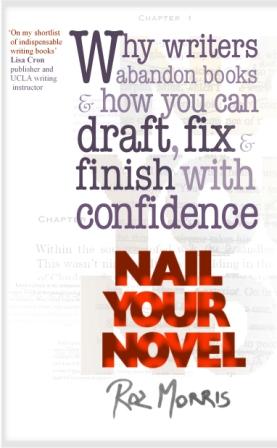
The second book is  “Nail Your Novel – Why writers abandon books and how you can draft, fix, and finish with confidence” by Roz Morris.

Image used with Permission

Image used with Permission

If you are a writer who has ever stumbled, fallen down, and/or quit working on a project, You MUST read this book. If you are just starting out and are looking for one book to HELP you get from idea to finished work. You SHOULD read this book before you put 60,000 words on the computer and find you don’t know where to go next.

Plans scare some writers. So, I will use the term method to describe what this book is about. The author lays out a method that takes the writer through a process of writing, rewriting, and polishing a story from start to finish. She begins by providing an index to resources for each topic that she will cover. That way if you are having trouble with scene structure, you can easily find it in the beginning of the book and go right to the section on Card Shuffling. In addition, she includes games, tricks, techniques and rescue remedies to help the writer walk through the method and finish their manuscript.

The author does a great job of summarizing each chapter and reminding the writer what they should be trying to get right during each stage of the novel-writing process and what the inner critic should or should not be doing. Her thumbnail tips throughout the chapters reinforce the method in simple language. The tools she recommends, including storyboard card shuffling and beat sheets, are tried and true and most important, they work.

Another positive is that this is not a three-inch thick tome that will take you a month to work through. At 175 pages, it is concise and just the sort of book you can keep close to your computer to quickly find what you need. If the book is not enough for you. Or, if you are like me and you have follow-up questions, the author’s blog site, ‘Nail Your Novel’ is full of additional advice and tips.

Both of these books now sit on the shelf closest to my writing desk, Both have numerous post-it flags attached at critical chapters. I’m not saying that these are the only books on writing craft you should own. What I am saying is my recommendation would be to add them to your collection. I know they will get lots of use.

 
4 Comments

Posted by on August 7, 2013 in Thoughts on Writing


Tags: , , , , , , ,