RSS

Tag Archives: Traditional Archery

Mirage

Retirement has been great! I want to say that first, before you get the wrong idea. In the two months since I walked away from the treadmill of working for someone else, my mind has drifted back to the office three times. In each case it was because a friend called with a question. Otherwise, I have not missed the daily grind…at all.

Now my plans for retirement included making more time to write, more time to blog, more time on the archery, pistol, and rifle ranges, more time fishing, more time working on and driving my radio-controlled trucks, more time reading, and more time traveling with my wife. That was my plan before I actually retired. But plans are like the waves of heat rising from the sun-baked earth, a mirage. They are never quite what we think they will be.

The reality has been: two weeks of pre-planned medical appointments, landscape work, home repairs, landscape work, repair a utility trailer, landscape work, remove diseased trees and buckthorn (black locust), landscape work, a trip to Iowa, a trip to Chippewa Falls, and some more landscape work. Along the way, I did finish the final chapter revisions of my novel, Snake Rattles and start the second book in the series. I also have been able to squeeze in a new truck build that is almost complete. Almost. Oh, And I did make it over to MN for the Father’s Day traditional archery shoot.

As you can see the work and play balance has been a little lopsided in favor of work. I have learned two very important things. One, at sixty-one and a half, I can still work hard and do the things that need to be done physically. Two, my body takes a bit longer to recover from moving a couple tons of rock than it did when I was twenty-three. Thank you OTC anti-inflammatory products.

The good news is the back log of projects is getting smaller and I’m getting more comfortable with the new schedule. By the way, I have been right for the past forty years, a one-hour nap in the afternoon should be mandatory in the workplace. It improves attitude and performance in every worker in my household. Write your Legislators and demand that they make this a law. Hell, they should be able to fit it into one of those otherwise meaningless multi trillion dollar bills they seem to pass every other month. Oops, I broke my own rule. Sorry.

Anyway, I do enjoy my new situation. I believe the work/play balance will improve and my initial plans will become more of a reality. Like a long-range precision shooter, learning to read the mirage is a key skill to becoming successful. I will watch the waves of my plan and make adjustments as necessary until I feel I have achieved the right mix of want tos and have tos.

 
2 Comments

Posted by on July 19, 2021 in Musings and Odd Thoughts


Tags: , , , , ,

Write what you know?

004


“Write what you know!”

Almost every ‘How To’ book on writing preaches this advice. For most non-fiction writers, this is sound advice usually is taken straight forward. Whether it is memoir, historical, How-to or any number of other topics, you should write about things that you know something about, are interested in or even want to know more about. It gives the reader a feeling of comfort knowing that the author isn’t just pulling information out of a hat.The author’s ‘expertise’ adds weight to the written words.

However, this advice can be very interesting advice when given to a fantasy fiction writer. Few of us routinely wield a sword or cast a magic spell. Fewer still have actually passed through a portal to find themselves in another realm where dragons, elves, wizards, and goblins walk the land. Most of the individuals that I have met who have taken the aforementioned journey are either sitting quietly in a catatonic state because they have left their material bodies behind. Or, they are unable to write about their journey because the medication they are given makes writing anything except their name difficult. So, how does a modern author use this advice and write about what they know?

Fantasy is created in one’s imagination. So, having a vivid imagination is a standard prerequisite. Those of us whose teachers wrote on our report cards that we spent too much time staring out the windows daydreaming were pretty good candidates. However, to draw a reader into your fantasy story, there has to be some measure of reality. Something familiar. Maybe it’s making a campfire, baking a loaf of bread, riding a horse, dressing a wound, or bartering with a merchant at the local farmer’s market. These types of skills obtained in modern society, can be easily converted to a fantasy story and in doing so, bring a sense of realism to the reader, drawing them into your world. If you are lucky enough to have hobbies like, archery, martial arts, herbalist, camping, astronomy, Chemistry, or being some form of entertainer, you have real expertise in areas that can easily be incorporated into a fantasy setting.  Your knowledge will, if used moderately and with skill, add authenticity to your world,

Another excellent source of knowledge for the fantasy writer is to have been immersed in a culture foreign to their own. Dealing with language, customs, food, clothing, and belief differences gives the writer unique insights and tolls to use when describing their world to the reader. Not only the differences themselves, but the feelings of having to deal with a foreign culture is a form of expertise that can be invaluable to the author.

If you still are not sure that you ‘know’ anything, here is an exercise to help you. Get a pad of paper and a pen, Give yourself 30 minutes to and hour of uninterrupted time. Write down things that you know about. Leave nothing out whether you think they can be related to your story or not. Start with your education. What did your like or do well at in school? What sports or social activities did you participate in? What did you do after school for fun? How did you fill your time during summer vacation? What did you do on the weekends? What do you do to relax, What do you do for fun? List places you have traveled to. What did you do there? What experiences did you have? What was the food like? Music? Dress? How did you feel being the outsider? What do you do for employment? Be specific and list tasks you perform. What are your hobbies? What are your chores around the house? By now you should be getting a very long list of things where you have some level of knowledge. Maybe even expertise. Keep this list handy and refer to it often to remind yourself that you do know something!

A very short list of my interests and knowledge base, that I use regularly when writing, includes: Cats, Native American Spirituality, Archery, knife-making, emergency medicine, herbal remedies, gardening, contingency planning, woodsmanship and fishing. My actual list filled two pages of a legal pad.

Now that you have determined that you do know something, look at the list and think about how you knowledge can be used to help strengthen your story. Maybe you need to add skills to one or more of your characters. Maybe you should add detail to your descriptions of scene.

NOTE: A word of caution! Adding too much detail about mundane tasks is a sure way to lose your reader. Remember that not everyone cares how many coals are required to bake peach cobbler in a cast iron dutch oven. (I seem to recall it was eleven on the bottom and seven on top. it has been a long time.)

Add just enough detail to add realism. If the details are important to your story then you have a little more leeway. Your beta readers or writing group can help you with how much is the right amount.

So, don’t be shy. Write about what you know. You know a great deal!

Let me know what you know. I’d love to hear it.

 
5 Comments

Posted by on April 6, 2015 in Thoughts on Writing


Tags: , , , , , , , , , , , ,

Vacation

I’ve been busy recently with vacation. It all started Friday before Father’s Day. The archery club I belong to, holds a traditional archery shoot every year on Father’s Day weekend. Shooters come from across the U.S.to participate in what many have called the finest traditional-only, 3D archery shoot in the U.S. Yes, I’m biased. However, when participants of the IBO World Championships tells you this, you tend to pay attention.

Only traditional equipment is allowed. Longbows, recurves, and primitive bows are the mainstay. no sights are allowed so instinctive shooting is required. Targets are commercially made three-dimensional life-like replications of real animals. They are accurate in size and shape. The main differences is the real animal does not have scoring rings etched into its side and it doesn’t hold still for very long. 🙂

Looking through the blind at the 3 dimensional  foam target.

Looking through the blind at the 3 dimensional target.


The three dimensional targets look very real, but they are made from foam rubber.

The three-dimensional targets look very real, but they are made from foam rubber.

The Shoot consists of three loops of twenty targets each. It’s a lot of work to put these kind of event on but the Club enjoys putting it together almost as much as the participants enjoy shooting it. I did say almost, right! Unfortunately mother nature had other plans for us. Friday was set up day and was beautiful. Saturday and Sunday were a wash out when we got five inches of rain. It cleared up a couple of hours before it was time to tear everything down, but attendance was terrible. Oh well, better luck next year. It will be our twenty-fifth year.

After the Shoot, I visited with my father and took a few days to go to the cabin. Most of my time there was spent getting it in shape for the upcoming July 4th celebration. Then a day of yard work at the house was quickly followed by a three-day writer’s conference called 4th Street Fantasy.

4th Street is a small convention by most standards, but what it lacks in size, it makes up for in content. Seeing friends from across the country, participating in panel discussions with world-class authors, sharing music circles and single malt in the evenings, all the while learning about the craft of writing; what better way to spend the last few days of vacation.  For those of you who love to write or read fantasy/science-fiction, this is a must to add to your bucket list.


Tags: , , , , , ,

Sad Ending

On Monday, I received an email from Ned Miller, the editor and founder of Stick and String Traditional Archery Magazine. It stated that as of September 1, 2014, the magazine would publish its last issue. The reason given was not being able to generate sufficient capital to maintain operations. For two and a half years, Stick and string has provided traditional archers with an alternative magazine that provided quality reading and informational articles.

In the Summer of 2012, Ned read my post Room to Write where I commented on my collection of traditional archery equipment. Ned emailed me, stated that he had a new magazine, and asked if I would be willing to write an article for the Fall edition. After a few emails we settled on a topic and my article, “The Bridge Method”, appeared in the September 2012 publication. Then in the Summer of 2013, Ned published my second article, “Extending the Length of Your Arrows”.

I feel privileged to have been involved in Ned’s magazine. Ned was always easy to work with and as a fellow archer, was open to articles discussing anything related to Traditional Archery. Though it didn’t have a huge circulation, I know the people who contributed to and read Stick and String will miss it. I know I will.

 
5 Comments

Posted by on June 2, 2014 in Traditional Archery


Tags: , , ,

Concentration

The Dot is one of the most basic forms of concentration exercise.

The Dot is one of the most basic forms of concentration exercise.

I’m going to take a departure from my usual fare and talk about one of my other passions. No, not fishing. The water is to ‘stiff’ right now for that. Unless you’re one of those people who think sitting on a bucket in -50 degree wind chills looking down at an eight inch hole in the ice waiting for a really stupid fish is fishing, I do not!

Nor, am I going to discuss the nuances of crafting a fine hunting knife from a piece of steel and a few scraps of wood and brass. Though that might be a good topic for a post some other time. Today I want to talk about archery and why I love it so.

I am a traditional archer, which means I shoot a longbows, recurve bows, or primitive (self) bows. I have owned and shot the modern compound bows with wheels and cams and sights and such. But, I found that I like the simple “Stick and String”.

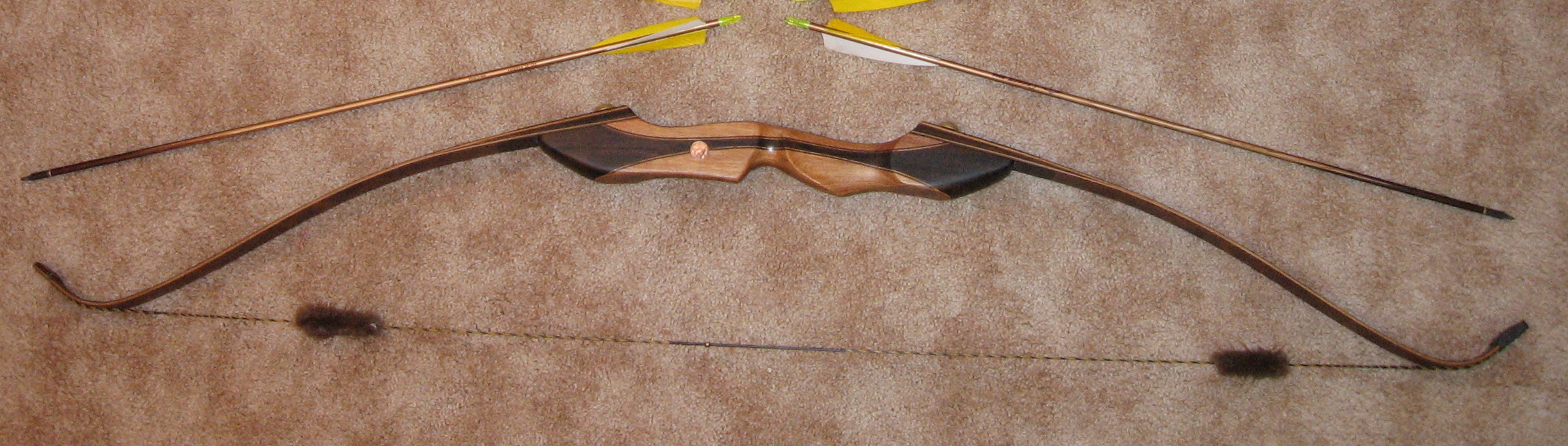
One of my recurve bows.

One of my recurve bows.

It started at a young age. My father would come home from work and even before dinner, the family would go into the back yard and shoot at a paper plate target pinned onto several straw bales stacked upon each other to form a backstop. We would spend hours in the evenings and weekends as a family shooting for fun. I the fall we would go to our vacation property in Wisconsin and bow hunt for the elusive White-tailed deer. Before I was old enough to go out on my own, I would tag along with Mom. Yes, my mother was an avid bowhunter long before it was fashionable for women to do so. She would find a place to stand along a likely deer run and sit me down at the base of a nearby tree to wait. usually, I would fall asleep. In high school, I gave up archery in favor of football and I didn’t take up the bow again until after I was married.

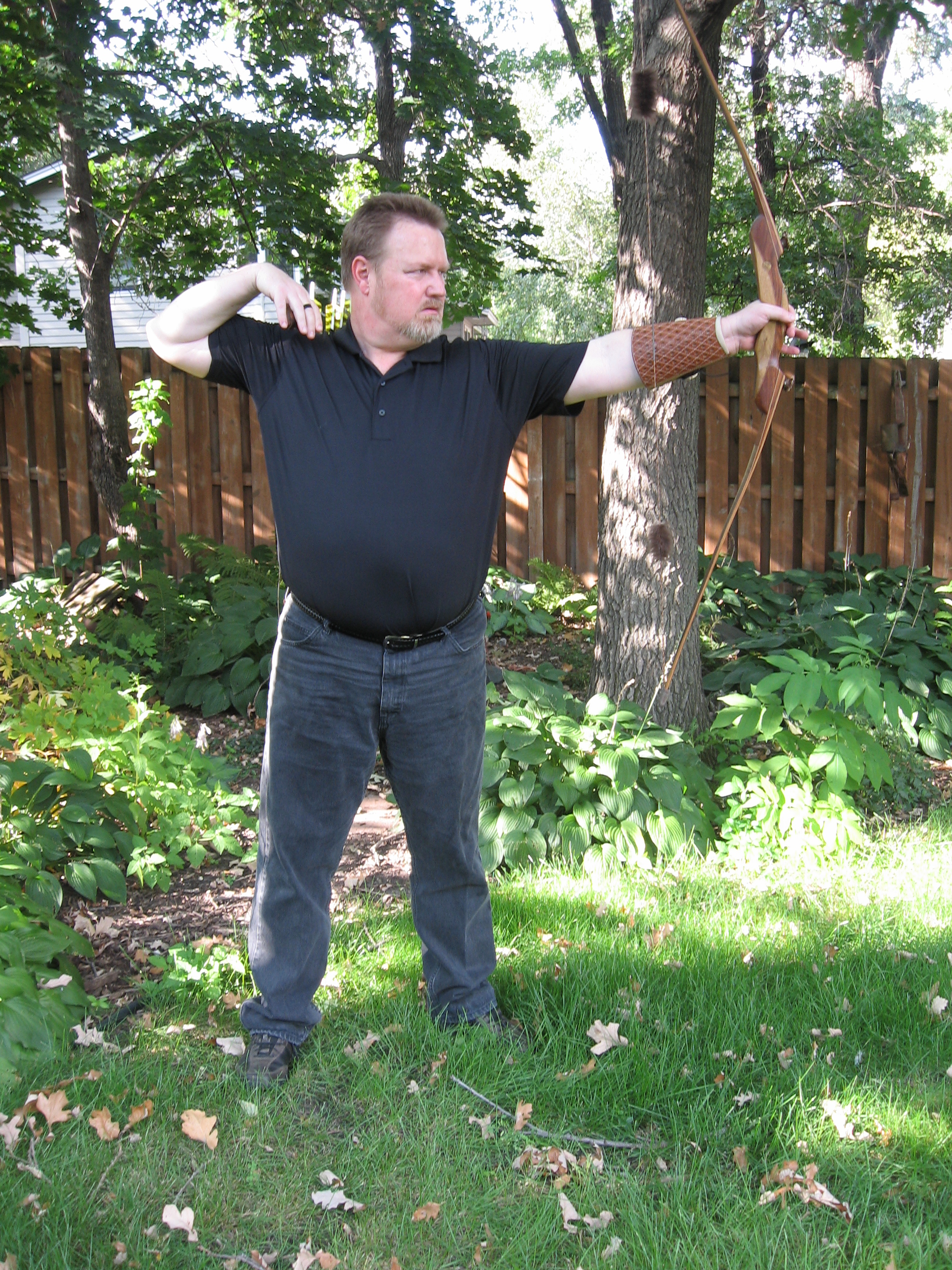
So, why does the ‘mystic flight of the arrow’ compete with my writing and fishing? They actually have a lot in common. The most important commonality is, for me at least, they take concentration. Different forms of concentration to be sure. But still the mind is exercised and stretched. During the ten to fifteen seconds of my archery shot sequence, I can not allow anything other than the shot to enter my mind. During the last few seconds before I release the arrow, there is only the small dot on the target. there is nothing else. only the dot. Where the arrow will ultimately strike. If I allow outside thoughts to enter in, the shot will be off. Once the arrow hits the target, my mind can relax until I am preparing the for next shot.This process of concentrate, relax, concentrate, relax, does a wonderful job of removing stresses of the day, calming the spirit, relaxing the body, and focusing the mind.

Look at the eyes, even after the shot. Concentration!

Look at the eyes, even after the shot. Concentration!

Then there is the satisfaction of watching the flight of a perfectly shot arrow. The unerring, arching path as the colorful feathered fletching rotates the shaft. Smooth arching flight. Over again and again. Each arrow carries with it negativity and stress. The perfectly shot arrow will always make you smile.

 
33 Comments

Posted by on January 30, 2014 in Traditional Archery


Tags: , , , , , ,

Opportunity Comes Knocking

A couple of months ago I received an email from a gentleman inviting me to write an article for his magazine, Stick and String Traditional Archery Magazine. Since the magazine’s focus is traditional and primitive archery and I have been involved in traditional archery for many years, it seemed like a good fit. Any opportunity to get material published should be considered. You never know when you will get another one.

After several emails to narrow down possible topics, I sat down, wiped the sweat from my palms, and began to put the bones in the old computer. The content of the Bridge Method article (which starts on page 16) is pretty straight forward. The article discusses how to transition from practicing your archery shooting form, to shooting at targets while maintaining the form you have developed. Archery like many sporting activities is 80% mental and 20% physical. The article discusses how the conscious and sub-conscious mind can work together to perform the perfect (repeatable) archery shot. I learned this training method from an archery coach who was a former world champion. This was a lot of fun to do and with luck, I will be asked to write more articles in the future.

With writing, like most things I enjoy doing, I can only get better if I practice. I have been making a conscious effort to expand my writing opportunities whenever and wherever I can. I participate in a number of writer’s groups,  am preparing two articles for publication in the Master Gardener columns of several local newspapers, and the article for Stick and String. The more ways I can find to write and practice the craft, the better I will be as a writer. I’m hoping that this practice will translate at some level to my fiction writing.

So, What are you doing to expand your writing opportunities?

 
10 Comments

Posted by on October 2, 2012 in Other Strangeness


Tags: , , , , , , , , ,

Father’s Day Tradition

If you have read my About page you know that one of my other passions is Traditional Archery/Bowhunting. You may be asking, what is traditional archery?

Here is the quick and dirty answer which will not satisfy the archers out there but will give the rest of you some insight. In today’s world of high technology, archery has not been left out. Typical archery equipment today consists of a compound bow made of aluminum and titanium, with cams, cables, fiber optic sights, stabilizers, bubble levels, carbon fiber and foam core limbs, carbon fiber arrows with plastic vanes, and arrow speeds of 300+ feet per second. These machines are very accurate. However, with so many moving parts, a lot can go wrong. Traditional archery is a throwback to an earlier time and is sometimes called a stick and a string. Longbows, recurve bows, and selfbows are typically made from wood with a Dacron string. Arrows can be carbon, aluminum, or more traditionally wood. The fletching consists of turkey feathers. There are no sights as the shooting is done instinctively, like throwing a baseball. It takes a lot of continued practice to reach a high level of proficiency.

Every year, over Father’s day weekend, my archery club, Rapids Archery Club, sponsors a traditional archery shooting event. For our Father’s day shoot we set up three sets of targets. Each set has twenty targets. The targets are life-sized three-dimensional foam replicas of animals that are legally hunted in North America and Africa. The targets are placed throughout the woods and fields that make up the 70 acre archery compound. We try to make the target sets look as real as possible.(See Slideshow from pervious shoots) Shots are taken from seven to thirty yards which, is within the effective range of the archery equipment being used. Set up usually takes all day on Friday with the shoot being conducted on Saturday and Sunday. Typically, we will have 300-500 shooters over two days. Though most shooters travel from neighboring states to join us here in Minnesota, some travel from as far away as Florida, Hawaii, and Alaska to join in the fun.

We encourage families to participate and we have separate divisions for youth and cubs (little kids). It is something special to see the look on a five-year-old girl’s face after she shoots her little pink arrow into a foam target of a life-sized moose. She can’t even reach up to retrieve her arrow. So, her proud mom or dad has to pull it free. It truly is a good time for the whole family. This was the twenty-second year we put on this shoot and each year it seems to get better. It is something that, those of us who help put it together, love to do and love to participate in. When it’s over and the targets have been torn down and stored away, we sit around drinking something cold. We  discuss the results and how we can make the event better for next year. With tired smiles we leave the archery compound and say to ourselves, “Only twelve months until next year.”

How did you spend your Father’s Day weekend?


Tags: , , , ,