RSS

Tag Archives: Writing

Fantasy tidbits

Today I am guest posting for follow blogger byjhmae. I was surprised when she asked me. But I jumped at the chance. She always has an interesting take on writing and current issues. If you have not already dropped by her blog, do so. You will not be disappointed. And today, you would get the added pleasure of hearing more from me. 😉

As the title suggests I talk about how fantasy and bringing different spiritual cultures together can create conflict. There are also a few other tidbits on fantasy writing and magic systems. Enjoy.

Fantasy – the purest form of fiction

 
6 Comments

Posted by on September 12, 2013 in Journey into Fantasy


Tags: , , , , , , , , ,

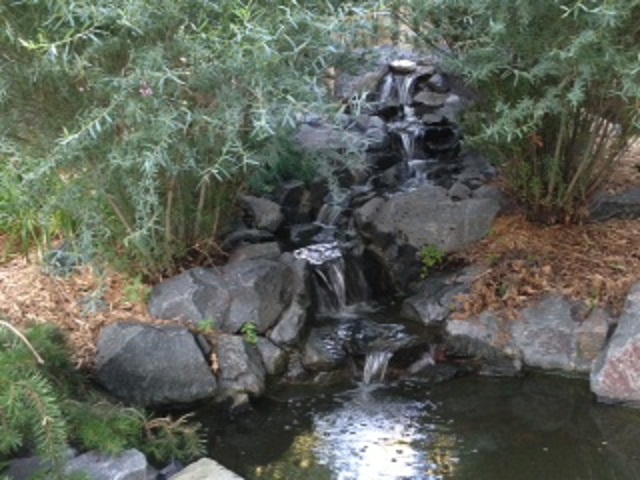
Mystic Waterfall

Mystic Waterfall (My Backyard)

Mystic Waterfall
(My Backyard)

I hear running water. The sound is muffled. I slip through the willows and white paper birch trees. The stream must be close by. Little breeze makes it down here in the valley. Yet, I can smell a freshness in the still air that was thick with pollen and insects.

The morning dew hangs on every leaf. The sun has not risen enough to burn the excess moisture away. Soon my shirt and hair are soaked. I wipe my forehead with my sleeve and press onward, searching for the source of the ever-increasing sound.

The willows become thicker with every forward step. Their branches slap against my face and arms as if trying to send me back the way I came. The ground itself becomes more uneven. Once soft moss-covered duff has turned into sharp rocks and boulders which invite me to turn an ankle.

I stop to get my bearings. The sound seems all around me now. The birch trees block my view of the sky. Every direction I look appears the same. I begin to panic. Wondering which way to go. I stumble forward. Fighting my way through the vast wall of willow branches. A branch hits my face and I close my eyes to protect them. The ground wins and I trip, striking my knee on a sharp boulder. My hands are cut on smaller rocks while trying to catch myself.

I open my eyes. There, just beyond my reach, I see myself looking back at me. I blink several time to clear my eyesight. There is no mistaking that the reflection of myself is coming from a small pool. the sound is now very loud and I look up into the waterfall that spills through the rocks. The willows converge a few feet above the pond and I cannot make out where the waterfall starts.

I pull myself forward and sit at the edge of the pool tending to my knee and hands. A movement on one of the rocks above me causes me to look up. A small creature steps out of the willows and onto a flat rock. Smaller than a child, it is hunched as if very old and uses a gnarled stick to lean on. It turns and with a voice that resembles rustling leaves, says, “Welcome, apprentice.”

Apprentice meets his mentor

Apprentice meets his mentor

 
2 Comments

Posted by on August 30, 2013 in Musings and Odd Thoughts


Tags: , , , , ,

Blood Power to Steam Power – Part 2

In my last post, I talked about my visit to the Mayan exhibit at the Minnesota Science Museum. This puzzling civilization was controlled by priests that obtained their power by blood sacrifices.For nearly four millennium they stood as one of the most advanced  cultures on earth. The reason for their decline is still a mystery.

The day following my trip to see the Mayan exhibit, I volunteered in a gardening Q&A booth at a small country town festival (threshing show) near my home. One of the key elements of this show was a historical accounting and progress of the steam-powered engines and specifically the farm tractor.

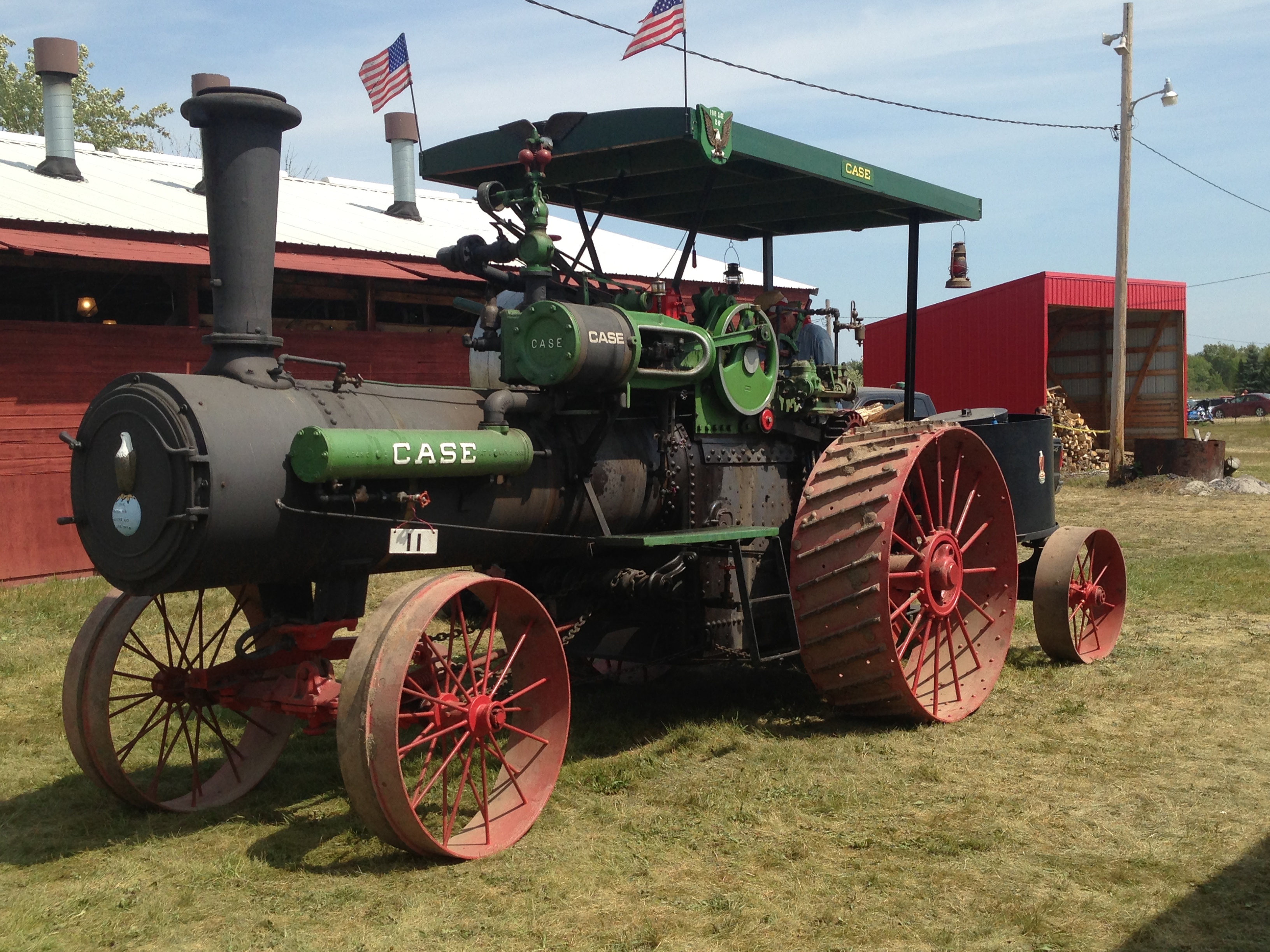
Coal-Fired Steam Tractor

1923 Case No. 11 Coal-Fired Steam Tractor

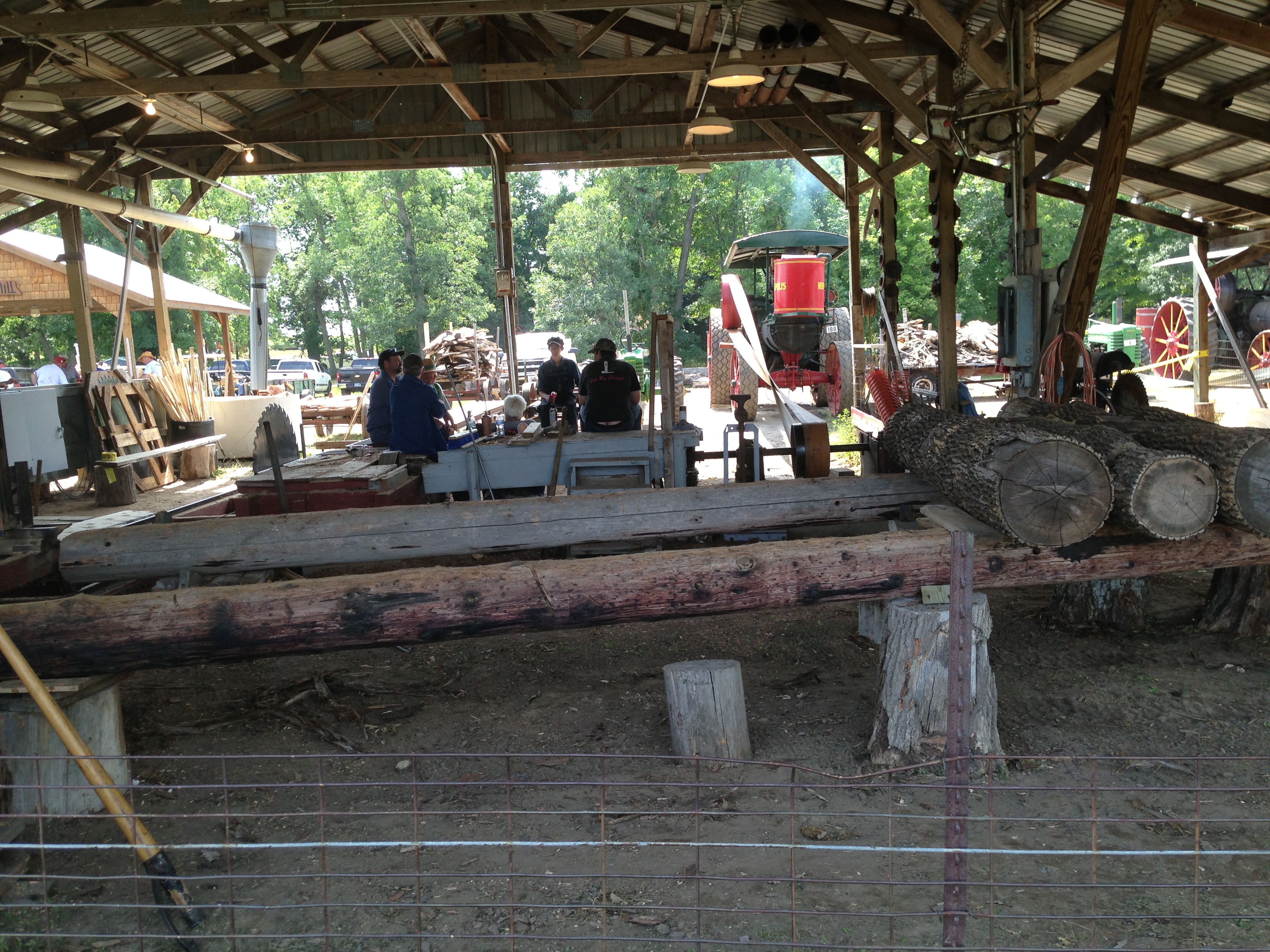
The festival grounds were covered with booths and exhibits of steam engines dating back into the 19th century. There were steam engines that would fit in the palm of your hand and steam engines that ran full-sized sawmills.

Cutting logs into boards

Cutting logs into boards – Note the blade on the left and the size of the man in the center.

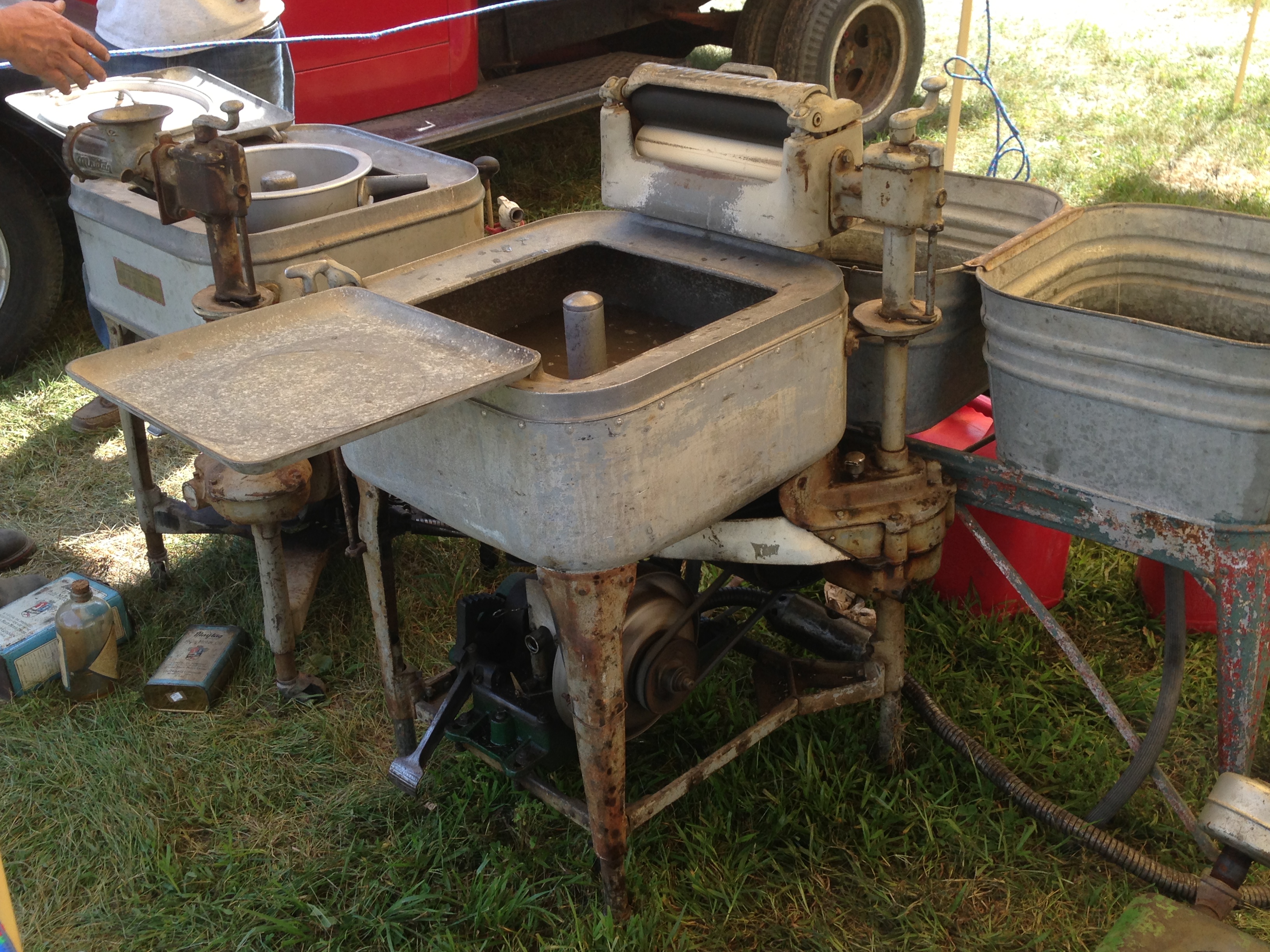
There was even a stem engine that ran a ringer washer.

No more hand cranking the ringer.

No more hand cranking the ringer. Watch your fingers!

In the eighteen hundreds, steam ran everything from Eli Whitney’s cotton gin to the Mississippi Queen-styled river boats. In short, the steam engine powered the industrial revolution. Most steam engines were powered by either wood or coal. The smell of a coal burner is unmistakable. The potential for the fires getting out of control or the boiler explosion from over-pressurization made early models somewhat dangerous to operate. However, the hiss…pop…hiss of a steam engine is very cool. And a hundred or so all running at the same time sounded like a really strange symphony.

So, for those of you writing historical fiction, steam punk, or historical fantasy, don’t forget to include these amazing machines in your story. Realism is what we are all after and there isn’t much that is more grounded and gritty than a good old-fashioned steamer, grinding and puffing in the background. Maybe it’s a turn of the century steam shovel working in a strip mining operation or a high-speed steamer headed for the Yucatan. Whatever you choose. these machines will help you bring your story to life.


Tags: , , , , ,

Blood Power to Steam Power – Part one

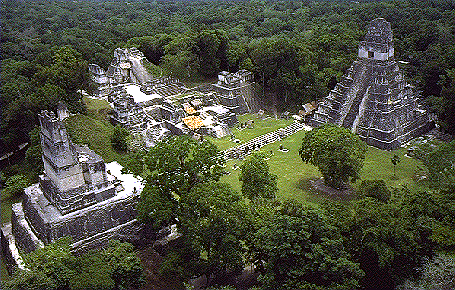
A Mayan City Center

A Mayan City Center  Photo credit to http://www.civilization.com

Blood sacrifice, Ritual beheadings, and games where the losing team captain is sacrificed to the gods, this is where my weekend started. No, not at the local parent/teacher association meeting. The domestic CEO and I went to the Minnesota Science Museum’s Maya Exhibit.

I have always been fascinated by the history and depth of this culture. Visiting the locations of these once powerful city-states has always been on my bucket list.

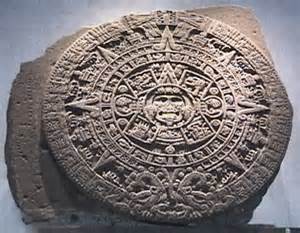
The juxtaposition of sheer intellect capable of tracking the stars and predicting celestial occurrences and the brutality of blood lettings and human sacrifice make this culture puzzling. The Mayan calendar and their pyramid-shaped temples are probably the most recognizable of the remains of this vast civilization that spanned from 1800 BC to 1450 AD..

However, their advances in medicine, dentistry, art, and agriculture remind us that this was a culture that supported tens of thousands of people without the benefit of ‘modern’ technology.

Two areas that really jumped out at me were the dental inlay work were gems and precious stones were placed into holes drilled into a person’s teeth using a simple bow-drill. Ouch! The part of the exhibit I found fascinating was a map that was created using laser photography from a low flying airplane to map the Maya city of Caracol in Belize. It revealed the existence of thousands of previously unknown roads, agricultural terraces and suburban housing settlements. The size of this city was awesome. The fact that the Mayans did not have horses or other means of travel other than by foot added to the magnitude of their way of life.

The two and a half hours we spent at the exhibit only fueled my desire to visit the actual sites. This trip has certainly moved up in priority on my bucket list.

From a writer’s viewpoint, the possibilities for story lines is truly endless. Obviously, historical fiction and fantasy are easy genres to leverage. However, so would romance, mystery and horror. Now I have to go back and watch, Mel Gibson’s action-adventure movie, “Apocalypto”, Just to see how the director recreated this marvelous culture.

In my next post, we’ll travel forward in time from the Mayans to the industrial revolution and my visit to a local festival that celebrates steam power.

 
6 Comments

Posted by on August 19, 2013 in Musings and Odd Thoughts


Tags: , , , , , ,

Writing Craft Help

I have a pretty extensive collection of books on the craft of writing. Not exhaustive by any stretch, but I have quite a few. At the recommendation of writer friends, I recently picked up two that I think are noteworthy.

The first one is a short (80 pages), but very useful book on editing, “Dunne with Editing, A Last Look at Your Manuscript” by Nann Dunne. Its focus is primarily on copy editing. The content is broken up into eighteen clear concise chapters that detail one part of the editing process. in addition, the author gives understandable examples showing before and after editing samples.

The book acts like an editing checklist. Chapters include the usual topics like spelling, passive voice and overused words. It also includes topics on participial clauses, dialogue punctuation, attribution tags, and the Burly Detective Syndrome. Am actual checklist is included in the appendices. As is a sampling of overused words and prepositions. the final appendices include short discussions on novel planning and structure as well as story arcs.

If you are looking for a ‘quick and dirty’ copy editing book to remind you of the little things and some big things to look at once you get past that first draft and before you pay for a professional to formally edit your MS, Then I would recommend adding this little gem to your craft library.

The second book is  “Nail Your Novel – Why writers abandon books and how you can draft, fix, and finish with confidence” by Roz Morris.
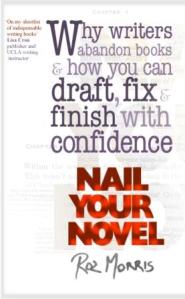
Image used with Permission

Image used with Permission

If you are a writer who has ever stumbled, fallen down, and/or quit working on a project, You MUST read this book. If you are just starting out and are looking for one book to HELP you get from idea to finished work. You SHOULD read this book before you put 60,000 words on the computer and find you don’t know where to go next.

Plans scare some writers. So, I will use the term method to describe what this book is about. The author lays out a method that takes the writer through a process of writing, rewriting, and polishing a story from start to finish. She begins by providing an index to resources for each topic that she will cover. That way if you are having trouble with scene structure, you can easily find it in the beginning of the book and go right to the section on Card Shuffling. In addition, she includes games, tricks, techniques and rescue remedies to help the writer walk through the method and finish their manuscript.

The author does a great job of summarizing each chapter and reminding the writer what they should be trying to get right during each stage of the novel-writing process and what the inner critic should or should not be doing. Her thumbnail tips throughout the chapters reinforce the method in simple language. The tools she recommends, including storyboard card shuffling and beat sheets, are tried and true and most important, they work.

Another positive is that this is not a three-inch thick tome that will take you a month to work through. At 175 pages, it is concise and just the sort of book you can keep close to your computer to quickly find what you need. If the book is not enough for you. Or, if you are like me and you have follow-up questions, the author’s blog site, ‘Nail Your Novel’ is full of additional advice and tips.

Both of these books now sit on the shelf closest to my writing desk, Both have numerous post-it flags attached at critical chapters. I’m not saying that these are the only books on writing craft you should own. What I am saying is my recommendation would be to add them to your collection. I know they will get lots of use.
 
4 Comments

Posted by on August 7, 2013 in Thoughts on Writing


Tags: , , , , , , ,

Writing Euphoria

Yesterday, I turned off my laptop and sat back in my chair. It took ten minutes before I realized I was grinning from ear to ear. I had only written a few hundred words. But, they were critical to the protagonist’s character arc. Before, the character’s motive seemed thin. They did not draw the reader in. There was no anchor point as to why the character would be acting the way I expected him to act.

Now, there was conflict, both internal and external. The foundation for the subplot was laid and I could easily build on it throughout the rest of the story. Most of the story, to this point, has been written as a series of flash fiction based on an image I had for a particular scene. It has worked great to get scenes written. However, they are not tied together very well and it’s missing depth of plot. I decided that to help with the story moving forward, I needed to go back and plug-in some detail.

Anyway, back to my grin. I was really happy with the way the scene came out as you can plainly see. I realized that this feeling of euphoria was something that I felt every time I finished a writing session. Even those times when writing was a struggle, I would finish the paragraph or sentence and sit back. I couldn’t help but smile.

Maybe it’s the joy of creativity. Maybe the feeling of crashing through a ‘block’. Maybe it’s the joy of using words to make pictures. Or, maybe it’s seeing the story unfolding before my eyes and feeling what the character’s feel. Whatever it is. I love it. It’s a drug that is drawing me into an addiction. When I’m not writing, I am thinking about writing and the story to come. I haven’t reached a point where I put the rest of my life on hold. But, I could see it happening. For now, I will write as often as I can and enjoy the glow that comes after each writing session.

How about you. Do you get a feeling of euphoria after a writing session? Does this feeling disappear after you have published a bunch of books? Lord, I hope not.

 
5 Comments

Posted by on July 29, 2013 in Thoughts on Writing


Tags: , , , , , ,

Women Protagonists in Fantasy Fiction

I recently listened to a panel of successful female writers and editors, from the fantasy genre, discuss female protagonists. As a male writer, I found it an interesting discussion. Hoping for some insight on how to make my female characters deeper and more real, what actually was discussed was a distinct dissatisfaction across the panel that most female protagonists in the fantasy genre were kickass warriors.

Hmm. Isn’t that feminist’s equality? I asked myself.

Hold on a moment. Before you all start to go off on me as being a sexist, let me continue. Everyone, myself included, was in agreement that a kickass warrior was infinitely better than the pretty pitiful princess that needs rescuing. The question became, “What other journeys are there for a female protagonist in a fantasy story beside Joseph Campbell’s ‘Hero’s Journey’?” Campbell’s journey is by far the most popular and most recognized.

Most fantasy stories have a hero of some sort as the protagonist. It just the way things are in the genre. Maybe because the standard good vs evil convention leads itself in that direction. There has to be someone to vanquish evil or evil will destroy everything.

It made me wonder about other potential character arcs. What other female specific arcs are there? As a matter of fact, I cannot remember hearing of any other character arc being ‘named’, let alone documented. What can I say, I’ve led a sheltered life. Shouldn’t any arc that you can find in literature be used in fantasy?

What other “journeys” are you aware of? Have they been documented in detail somewhere? What have you used? Have kickass female warriors become merely a cliché? Boy, I hope not! It’s hard to beat a story about a woman who goes around kicking ass and taking names.

Your Thoughts?

 
18 Comments

Posted by on July 23, 2013 in Thoughts on Writing


Tags: , , , , , , , ,