RSS

Tag Archives: Characters

Storytelling Through the Written Word

share-your-story

We all think we have a story to tell. If not, why would we want to become writers? As writers, telling stories is what we do, isn’t it? Let’s find out.

The website, Storytellingday.net, defines storytelling as: “An art form of conveying a series of events in words, images, and sounds, which are often supported by creative thinking or an exaggeration.” The National Storytelling Network (Untied States and Canada) website defines it as: “The interactive art of using words and actions to reveal the elements and images of a story while encouraging the listener’s imagination.” Keeping in mind that these organizations refer to the oral tradition of storytelling and we are discussing written storytelling, I’m going to take a liberty and use readers where they use listeners.

Storytelling is, in fact, an oral tradition that goes back as far time itself. Some have postulated that the first stories were told to explain a failure. Hmm… “..supported by creative thinking or an exaggeration.” maybe that’s were fishing tall tales got their start. Sounds like fiction to me. We will come back to this later.

I remember as a boy sitting around the campfire listening to my elders tell stories about hunting, fishing, working on the railroad, or humorous war stories. I sat enthralled for hours. To this day I love to hear a good story told well. One of my favorite movies, “Out of Africa”, has a character that is a great storyteller. She is given the names of a couple of characters by her audience and she then creates a story off the top of her head that may go on for hours.

For the purpose of this post, I will define storytelling as: “Using written words that encourage the reader to use their active imagination, to create a sensory-laden story where the reader is fully engaged.” Now let’s see if can explain myself over the next few paragraphs.

The easy part is the first part. As writers, we use written words. On occasion, we can use cover art or illustrations to help convey story. However, words are our world. There are a lot of words at our disposal. Some are better than others. This is where the writer’s craft comes into play. The writer needs to select the best combination of words to help the reader create a real world. Choosing the right words is the art of writing. There are libraries full of how-to books on writing. Nearly all of them have good advice. But, ultimately, it is up to the writer to choose what works best for the story in question.

We have little control over the quality of the reader’s imagination. Each person is different. Some people can take a few words from a writer and create a whole fantastic world. Those reader need very little setting detail get into the story. Others can’t imagine anything that is not actually resting in their hands. All of the flowery descriptive prose in the world is needed to help them “see” what the writer sees. A writer must know their audience so as to chose the best words to fire what imagination the reader has.

If we want to reader to hear sounds, smell odors, feel textures, taste flavors, we must use words to help the reader build those things. Storytellers using the written word must choose their words carefully to help the reader create the real story in their head. Writers, just like in the oral tradition, must incorporate each of the reader’s five senses. The writer must see, hear, feel, taste, and smell the world they are trying to put to paper. The more vividly we write, the easier it is for our audience to be completely absorbed into the story. One of the keys to good writing, in my humble opinion, is to add the sensory details to the story without spending a page and a half explaining what a sunrise looks like. A few words scattered here and there within the action of the scene seems smoother and more interesting to read than an info dump.

Isn’t what what we’re after, as storytellers, is for the reader to be completely absorbed in the story? Have you ever read a book and become so engrossed in it that you find yourself laughing out loud? Or, you feel the character’s frustration and cry out in anguish? Or, feel the pain of the character’s loss and begin to cry? When that happens, the writing storyteller has accomplished the task at hand.

That brings us to the question of “…use of creative thinking or exaggeration.” On the surface this would push the storyteller toward the realm of fiction. However, non-fiction writers, do not despair! Even textbooks can be written in such a way as to draw the reader into the subject matter and still be truthful. The use of real-life experiences, anecdotes, and examples can help to make even the driest material palatable  Exaggerations can also be used to help prove a point. I have not seen a lot of this technique used in pure non-fiction. However, I’m sure it has.

Good writers are indeed storytellers, regardless of their genre of choice. Becoming a good writer is what we all strive for. The good news is, we ALL have a story to tell.
 
7 Comments

Posted by on January 8, 2013 in Thoughts on Writing


Tags: , , , , ,

When is a Prologue not a Prologue?

Much of my writing time of late has been spent, as it should be, on my current WIP novel, “Smoke and Goblet”. I wrote what I thought would be the opening scene quite a while ago. My writing group critiqued it and I made revisions. Thinking I had a solid opening scene, I moved on to writing other scenes that would round out the first third of the book. Several of these scenes introduced other major characters and gave additional exposition regarding the main conflict. While writing a scene introducing my primary antagonist, I hit a wall. The scene just did not feel right. It read like a flashback based on the preceding scenes.

I went to my storyboard and moved some scenes around. The logical place for this scene was the opening scene. I based this on the flow of ownership of the object that causes the main conflict in the plot and not on which character is introduced first. It just made more sense to me that the reader would want to know how the object got to where the protagonist obtains it. Also, it is a great set up to show just how nasty the antagonist is.

My dilemma came from several writing sources which stated, “Anything before the protagonist is introduced, is a prologue.” These sources further state that, “Prologues, with few exceptions, should be avoided.” Prologues require the author to write two opening scenes which cause the reader to start the story over. A prologue often contains characters other than the main characters of the story, is set in an early time, and/or is located in a different setting. It is a set up that may provide exposition the author can think of no other way to introduce to the reader. I have read novels with and without prologues and I understand what the writing sources were trying to say. I think most stories can do without a prologue quite nicely. That brings me back to the question of this post.

My opening scene introduces my antagonist, his evil personality, and the object which will be the main cause of conflict for the remainder of the story. The second short scene shows how the object changes hands before the protagonist is introduced and obtains the object in the third scene. I do not believe that the first two scenes fit the definition of a prologue as the timeline, antagonist, and conflict are consistent with the rest of the story plot. I’m not adverse to using a prologue. I’m just not sure that is what I’m dealing with.

So…when is a prologue not a prologue? Have you used a prologue in your writing? Did an editor ask you to either add or delete a prologue? What was their reasoning?


Tags: , , , , , , , , , , ,

Writing is like a Train

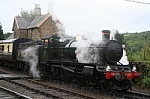
For me writing is like a train.Train

The Warm Up:

Train: The engineer gets into the locomotive, turns on the power, and fires up the engine.

Writer: I create characters that I think will be interesting. Next comes a situation the characters find themselves in that will create tension and lead to further adventures. The setting is somewhere within the fantasy world I created years ago. Finally, I gather my plot notes (islands), character sketches (Traits and Tags), and a big bottle of water and head to the Storyboard. Once the islands have been laid out, I go to the computer.

Leaving the station:

Train: The locomotive winds up and builds to a roar. The train begins to inch forward. It crawls along for a few yards as the full weight of the train is taken on. Now there is some momentum and the train begins to pick up speed.

Writer: The blank screen is deafening. My mind is full of the possibilities that await the characters but, nothing is happening. There is a moment of panic and self-doubt. My hands reach for the keyboard as I try to formulate the first sentence. It has to be the best sentence of the story. The hook has to be perfect. I stop and take a drink from the water bottle. Then I remember that the first draft is always crap. My hands return to the keyboard and I peck out the first sentence. No, it’s not perfect but, it is a start. Take another drink. Back to the keyboard. Soon the first paragraph is complete and the head is getting into the game. Each paragraph that follows is easier than the last.

Coming up to speed:

Train: The train accelerates to its cruising speed. The power and momentum seem unstoppable. The cars jostle around over the uneven tracks. However, the train keeps going forward.

Writer: Once I get into a writing rhythm, woe unto any who disturb me. My mind is in high gear and the fingers begin to have a hard time keeping up. I have become the characters at his point and the story flows out like a lake draining though a broken dam. I just stay out-of-the-way and let it happen.

Coming into the next stop:

Train: The Engineer reduces the power and the train begins to coast. The friction of the wheels against the steel rails begin to slow the train down. As the train enters the station, the brakes are applied. The momentum of the train strains against the brakes because it wants to keep going. At last the train jerks to a halt and the sound of the locomotive drops to a hum. It’s not off, just waiting for the command to crank it up again.

Writer: The mind is racing forward ahead of the fingers and it sees the end of the scene/chapter/story before the fingers do. Once the mind reaches the end, it begin to coast. The fingers continue to bang away but by now fatigue is beginning to set in. The keystrokes are becoming softer and begin to slow down. The final paragraph flows forth but much weaker than before. Finally, the fingers type out the last few words and then become motionless on the keys. The Save button is pressed. The mind, however, is already working on the next scene/chapter/story. Wanting to move forward.

 
8 Comments

Posted by on December 5, 2012 in Thoughts on Writing


Tags: , , , , , , , ,

Next Big Thing

I have been off participating in other areas of my life for the past couple of weeks.

What do I find when I return but a very nice tag from Anne Woodman. The Next Big Thing is a fun little exercise going around some areas of the blogging world. You are asked to provide information on your current project.The topic for my next several posts will be WIP so, this makes a great segue.

Here goes.

What is the working title of your book?
Smoke & Goblet

Where did the idea come from for the book?
I have always liked the Luther Whitney character in Clint Eastwood’s movie, “Absolute Power”. It was a very different role for Eastwood and the Luther character was full of depth and interest. Seeing this type of character in one of the cities of my world was easy and helps me flesh out details relating to world-building.

What genre does your book fall under?
Fantasy – Sword and Sorcery

Which actors would you choose to play your characters in a movie rendition?
I’m not very good with actor’s names. The only one that comes to mind to play the main character is William H. Macy.

What is the one-sentence synopsis of your book?
When Liam Livsey tries to fence a stolen item, he finds out that this bauble is actually a phylactery that contains the source of all fear; and that the former owner stole it from a necromancer, with an insatiable appetite for new thralls, who is more than willing to add Liam, and everyone the thief knows, to his collection of souls if the phylactery is not returned.

Will your book be self-published or represented by an agency?
The original plan was to obtain an agent. That may change as I get closer to completing the manuscript.

How long did it take you to write the first draft of your manuscript? May we see an intro?
Currently unfinished. The target date for first draft completion is March 2013. Total time would be a little over a year. As for seeing an intro, I will be posting that in an upcoming post.

What other books would you compare this story to within your genre?
“Raven’s Strike” and “Ravens Shadow” by Patricia Briggs; “Witch” and “Warrior” by Marie Brennan

Who or what inspired you to write this book?
As I stated earlier, I love the character. The other area I want to explore is the different types of fear, their sources, and how fear affects different personalities.

 What else about your book might pique the reader’s interest?
Adoption relationships, death and necromancy, interesting settings within a fantasy city.

I am tagging some of the next big things:

Scott Weber

4amwriter

Shannon M Howell

Corey M P

Elisa Nuckle

Rules of The Next Big Thing:

*Use this format for your post
*Answer the ten questions about your current WIP (work in progress)
*Tag five other writers/bloggers and add their links so we can hop over and meet them.

 
8 Comments

Posted by on October 29, 2012 in Journey into Fantasy


Tags: , , , , , , , ,

Liebster Award

Cassidy Cornblatt AND Sara Flower were kind enough to nominate me for the Liebster Blog award on the same day! The winning lottery numbers are…..

Translated from German, Liebster Blog means “Dearest Blog”. Thank you Cassidy and Sara. All Blog awards seem to have rules attached to them so here they are for the Liebster.

The Rules:

  • Answer the eleven questions your nominator posed to her/his nominees
  • Write eleven questions to pose to your own nominees
  • Pass the award on to eleven others

Here are my answers:

1. Why are you a writer? Because I already tried to sing and dance! Seriously, I have always been a storyteller. I just decided to go from verbal to written word.

2. How do you come up with your ideas? Keeping an open mind and day dreaming…alot!

3. Where is your favorite place to write? My home office or on the deck at the cabin.

4. What do you do besides writing? I have interests that would fill up a legal pad. However, the ones that get the most of my attention are archery, fishing, knife-making, gardening, and reading when I’m not creating business continuity plans at my full-time job.

5. Is writing a hobby for you or a career/career path? It is a hobby that I am trying to convert to a career.

6. Do you think writers should have to be decent editors of their own work? I believe that I have to do a good job of editing before it goes to my test readers to ensure they can focus on the areas I need help with. The cleaner the MS is prior to them getting it. the better it will be when they finish with it.

7. What do your friends/family members think of you writing? They are supportive and helpful as alpha readers.

8. Do you have any inhibitions when it comes to writing? Yes. Writing sexual scenes are awkward and difficult to get right.

9. What type of main character do you prefer to write/read about? Characters who have had a difficult time with life but have achieved some level of success. They still have major flaws that cause them no end of grief as they tackle the challenges of the main plot.

10. Do you prefer writing or reading? I am leaning toward writing as I get better at it.

11. How often do you write? This is a tough one. I try to write something every day. For sure, I write a few times a week.

Here are my questions for my nominees:

1. What is your favorite POV to write in? Why?

2. What are some favorite objects that share your writing space?

3. What do you do besides writing?

4. Dogs or Cats?

5. How often do you submit work for critique to your writer’s group?

6. What are your favorite books in your genre? Outside your genre?

7. When writing, how do you connect with a character that is your polar opposite?

8. Why do you write in your chosen genre?

9. If you could sit down with a famous author for an hour, one on one, who would it be and why?

10. Do you read more or less than you did in High School?

11. What do you enjoy doing when not at work or writing?

The following Blogs are excellent locations for advice, ideas, and humor. I admire and respect everyone of them. (I have left a few others off this list only because they were nominated with me as well.)

My “Dearest Blog” Nominees are:

http://shannonhowell.wordpress.com/

http://annewoodman.wordpress.com/

http://beanovelist.wordpress.com/

http://scottweberwriter.wordpress.com/

http://lsengler.wordpress.com/

http://coreymp.wordpress.com/

http://4amwriter.wordpress.com/

http://robincoyle.wordpress.com/

http://carliemacullen.wordpress.com/

 
3 Comments

Posted by on September 4, 2012 in Other Strangeness


Tags: , , , , , ,

Writing Cross-gender

The other day, a friend asked me an interesting question. Noting that the main character in my short story is a woman, my friend asked, “Why did you use a woman? How can you know what a woman would do in the situations you put her in?”

Uh-oh! this is going to be a tightrope walk.

My response was the best I could come up with on the fly.

“That’s a good question. It was a conscious decision to use a female for a couple of reasons. First, I had never used a female as a main character and I thought it would be fun. Second, it would force me to look at things from a perspective that was outside my comfort zone. It was a challenge I hope I learned something from.”

My friend seemed to accept my answer for now.

Let me lay some ground rules for this discussion..

First, as a man, I know nothing about what goes on inside a woman’s head. Any man who says otherwise is a fool! I say this having spent 31 years living happily with the same woman. There is a sign that hangs in our family room that I try to live by. It says, “There are two theories to arguing with a woman…Neither one works!”

Second, as a man, I know that women don’t have a clue as to what goes on inside a man’s head. Say what you want ladies, but you don’t.

Third, and probably the most important, all men are not alike and all women are not alike. I have worked with women who could out swear, out fight, and out drink ninety percent of the male population, then turn around, put on an evening gown and dazzle that same group of men with charm, grace, and elegance. I have also worked with straight men who could quote every sport statistic, hunt and fish all day, put a tune on the Harley motorcycle and also have that almost magical ability to communicate with women to a point where they have more female bff’s than male.

So, based on this information a possible response to the question asked could be, “It does not matter, we are all basically the same.” Now I did not say it was the right answer, only a possible answer. I think it is way too simplistic and a cop-out.

When I build characters, I consider basic Myers-Briggs personality types. I layer on things like sociopolitical structure, geography, number and type of siblings, birth order, physical features, education, goals, lifetime achievements and traumas. Why on earth would I not consider gender and its effects on personality? How an individual responds to the above listed influences are greatly affected by gender. If my character comes across as a little manly at times, maybe it’s because she grew up in a matriarchal society that values skill at arms. Maybe, she is gender neutral in her sexual orientation. Maybe, I screwed up and had her behave out of character. Hey these things happen. That’s why I edit my drafts, repeatedly.

Like it or not, there are some basic psychological differences between the sexes. I am not an expert on the subject but, as a writer I have various reference materials to assist me when I need help on difficult subjects. Back in 1993 a book came out that seemed to get close to the reality of those differences, Men Are from Mars, Women Are from Venus: A Practical Guide for Improving Communication and Getting What You Want in Your Relationships by John Gray. I found it very interesting how close to the mark he was on how men really are and what makes them tick. I asked my wife and she confirmed that he was close on the women’s side as well. Though nothing is perfect, I refer back to both this book and my wife when I am stuck as to how my character would respond. Between the two I can get a pretty good idea as to how the character should act.

The bottom line is that I want my characters to be real and true to themselves whether they happen to be male, female, or something else (remember, I write fantasy). If a test reader calls me out, that a character is acting out of character, I will look very hard at why I chose those actions. I think that is the best I can do.

Please weigh in on this one. I would love to hear your thoughts.

 
10 Comments

Posted by on August 13, 2012 in Other Strangeness


Tags: , , , ,

Everyone has a story

It is that time again where the world becomes a single spectator for seventeen days. The Olympics open this Friday and are a spectacle so grand that the entire world stops for a moment to watch. For seventeen days, we watch the competition, the emotion, the determination, the courage, the joy, the heartache, the drama. As a former non-worldclass athlete, I can only dream of what it must be like to step on that podium and be heralded as the best in the world. To represent one’s country on such a grand stage must be a moment of a lifetime.

The competition is exciting and dramatic as it should be. However, the part of the television broadcasts that I enjoy most are the personal stories about the athletes. Every athlete has a unique and interesting story about who they are and how they became the best they can be. They all had major sacrifices and overcame huge obstacles. All have interesting character traits. They had support from various people and had their share of rivals who tried to keep them from realizing their dreams. They have finally made to the pinnacle of their sport, a few short days, hours, minutes, seconds, and even hundredths of seconds away from their goal. Still, there are obstacles to overcome and anti-heros from other countries to vanquish. Their life’s journey is coming to a climax!

Does this sound familiar?

Before you lies seventeen days of grist for the mill. If you cannot find a usable plot or character out of what you will hear and see,… well… you will. I have faith in you. Personally, I’m looking for someone I can love to hate. I know they’re out there. I just need to put my twisted hat on and tweak their life story a bit. Oh, I am so looking forward to it.

So Friday night, with pen and notebook in hand, I will in front of the tube looking for the perfect villain. I hope to hear about your finds in the near future.

 
19 Comments

Posted by on July 24, 2012 in Other Strangeness


Tags: , , , , ,